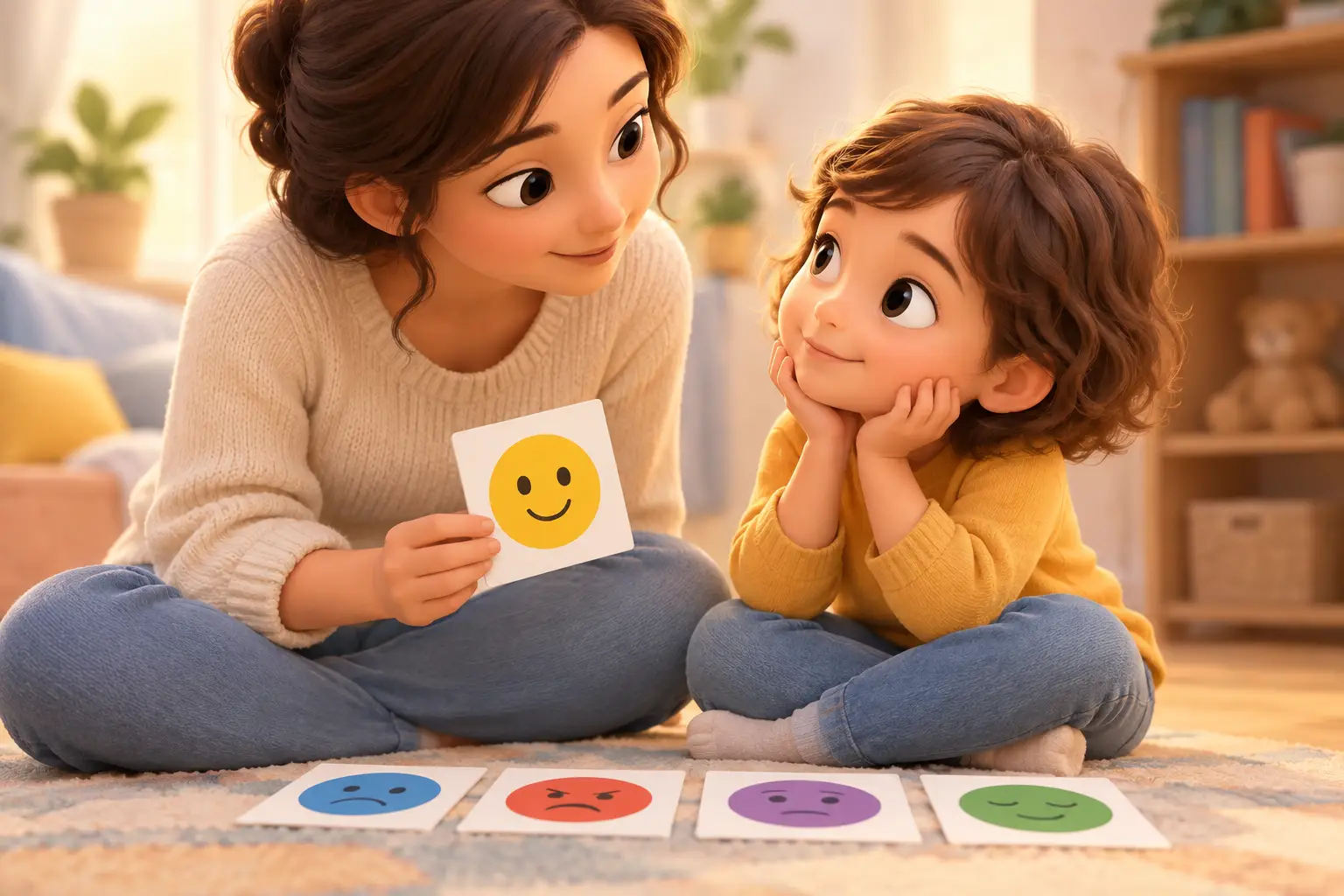
A preschooler may sob because her banana broke, then laugh two minutes later when the family dog sneezes. These quick turns can leave adults wondering, when do kids understand feelings? The gentle answer is that understanding begins very early, but it grows slowly through thousands of small, supported moments.
For children ages 3 to 6, feelings are real and powerful long before they are easy to name, explain, or manage. A child may know that something feels bad without knowing whether it is disappointment, embarrassment, worry, or tiredness. They learn those differences when loving adults put calm words around what they see.
When Do Kids Understand Feelings? It Happens in Layers
Children do not wake up one morning with a complete understanding of emotions. Emotional learning develops in layers: first noticing feelings, then naming them, then recognizing them in other people, and eventually choosing what to do with them.
Even babies notice facial expressions, voices, and changes in the emotional atmosphere around them. By the preschool years, many children can identify simple feelings such as happy, sad, mad, and scared. They may point to a worried face in a book, announce that a character is angry, or tell you, “I’m mad!” when it is time to leave the playground.
That is meaningful understanding, even when it looks messy. A child who can say “mad” may still hit, yell, or cry. Naming a feeling is only the beginning. The ability to pause, remember a coping tool, and use it in the heat of a hard moment takes much more time and practice.
Ages 3 to 4: Big Feelings, Simple Words
At ages 3 and 4, children are beginning to connect body sensations and situations with basic emotional words. They may understand that a scraped knee brings sadness or pain, a lost toy can feel upsetting, and a hug can help someone feel better.
Their view is still very centered on their own experience. If another child cries because they want a turn with a truck, a preschooler may understand, “He is sad,” but struggle to see why. They may also believe that because they want something, everyone else should want it too. This is a normal part of early development, not a sign that a child lacks kindness.
At this age, short and clear language works best. “You are sad because we had to leave.” “Your friend is crying. She wanted a turn.” “You are angry, and I will help you stay safe.” Repeated phrases give children words they can borrow before they can find their own.
Ages 4 to 5: Beginning to See Another Point of View
Many 4- and 5-year-olds begin to notice that two people can feel differently about the same event. One child may be thrilled by a loud birthday party while another covers their ears and wants to go home. This can be a surprising idea for young children, and stories are a lovely place to explore it.
They also begin to understand causes that are less visible. A child may recognize that Dad looks disappointed because the picnic was rained out, or that a friend feels nervous before a new class. Their guesses will not always be accurate, but the act of wondering matters.
This is also an age when children may use emotion words dramatically. “This is the worst day ever!” often means, “I am very upset right now.” Rather than correcting the size of the statement, try meeting the feeling underneath it: “It feels really awful that the block tower fell down. Let’s take a breath, then see what you want to do.”
Ages 5 to 6: More Nuance, Still Plenty of Support Needed
By kindergarten and early elementary school, many children can understand more detailed feelings, including pride, jealousy, loneliness, frustration, and disappointment. They may be able to explain what happened before they got upset, especially after they have had time to settle.
They are also more able to understand mixed feelings. A child might feel excited about starting school and nervous about being away from home. Still, knowing about mixed feelings does not mean they can calmly handle them every time. Hunger, tiredness, change, noise, and disappointment can quickly make a child’s emotional skills harder to reach.
Think of emotional understanding as a path, not a test. A child may show wonderful empathy one afternoon and melt down over the wrong color cup the next morning. Both moments can be true.
What Helps Children Make Sense of Feelings
Children learn emotions through warm relationships, not lectures. They need to feel that all feelings are allowed, while not every behavior is allowed. “It is okay to be angry. It is not okay to throw the book at your brother” gives both comfort and a clear boundary.
One of the simplest tools is narration. When your child is calm enough to listen, gently describe the moment without judgment: “You were hoping for the red cup. When it was in the dishwasher, you felt disappointed.” This helps connect an event, a feeling, and eventually a response.
Stories, songs, and pretend play can help because they create a little space around hard emotions. It may feel safer for a child to say that a small bear is worried about the dark than to say, “I am worried.” A familiar character who takes a breath, asks for help, or tries again gives children a simple emotional script to practice. Cozy Pebble Stories is built around these small, repeatable moments of comfort and courage.
Keep the Feeling Words Close to Everyday Life
You do not need a special lesson each day. Feeling language can fit naturally into ordinary moments. At breakfast, you might say, “You look proud that you poured your own milk.” After a disagreement, try, “Were you frustrated when the game changed?” At bedtime, a quiet question such as “What was one happy part and one hard part of today?” can invite reflection without pressure.
It can also help to name your own feelings in a steady, child-friendly way. “I am feeling frustrated because we are running late. I am going to take a slow breath and pack our shoes.” This teaches children that grown-ups have feelings too, and that feelings can be handled without becoming frightening.
Avoid asking a distressed child to explain too much in the moment. When a child is crying hard or shouting, their thinking brain may not be ready for a conversation. Start with safety and connection: get low, speak softly, and offer simple choices. The teaching can come later, when their body is calm again.
Why Empathy Does Not Always Look Like Sharing
Parents often hope emotional understanding will lead neatly to sharing, apologizing, and gentle behavior. Sometimes it does. But a child can care about a friend and still be unable to give up a favorite toy. They can understand that a sibling is sad and still feel annoyed by the crying.
Empathy is not the same as perfect self-control. Young children are learning to hold their own needs alongside someone else’s needs, which is a big task. Instead of asking, “Why can’t you be nice?” offer a bridge: “You both want the train. Sam is sad because he is waiting. You can have one more turn, then we will help Sam have a turn.”
This approach respects the child’s feeling while guiding the next kind action. Over time, those repeated experiences build both empathy and cooperation.
When a Child Needs a Little More Help
Every child develops at their own pace. Temperament matters. Some children are naturally observant and tenderhearted, while others express emotion with movement, noise, or quick action. Language development, sensory sensitivities, family changes, sleep, and stressful experiences can all affect how a child shows what they understand.
Consider checking in with your child’s pediatrician or an early childhood professional if your child rarely responds to comfort, seems unable to recognize basic emotions over time, has very frequent or intense reactions that disrupt daily life, or loses emotional or language skills they once had. Seeking support is not about labeling a child. It is about making sure they and their family have the care they deserve.
The most helpful message a child can hear is not “Stop feeling that.” It is “I see that this is hard, and I am here with you.” With patient words, comforting routines, and stories that make room for every feeling, children slowly learn that emotions may be big, but they do not have to face them alone.