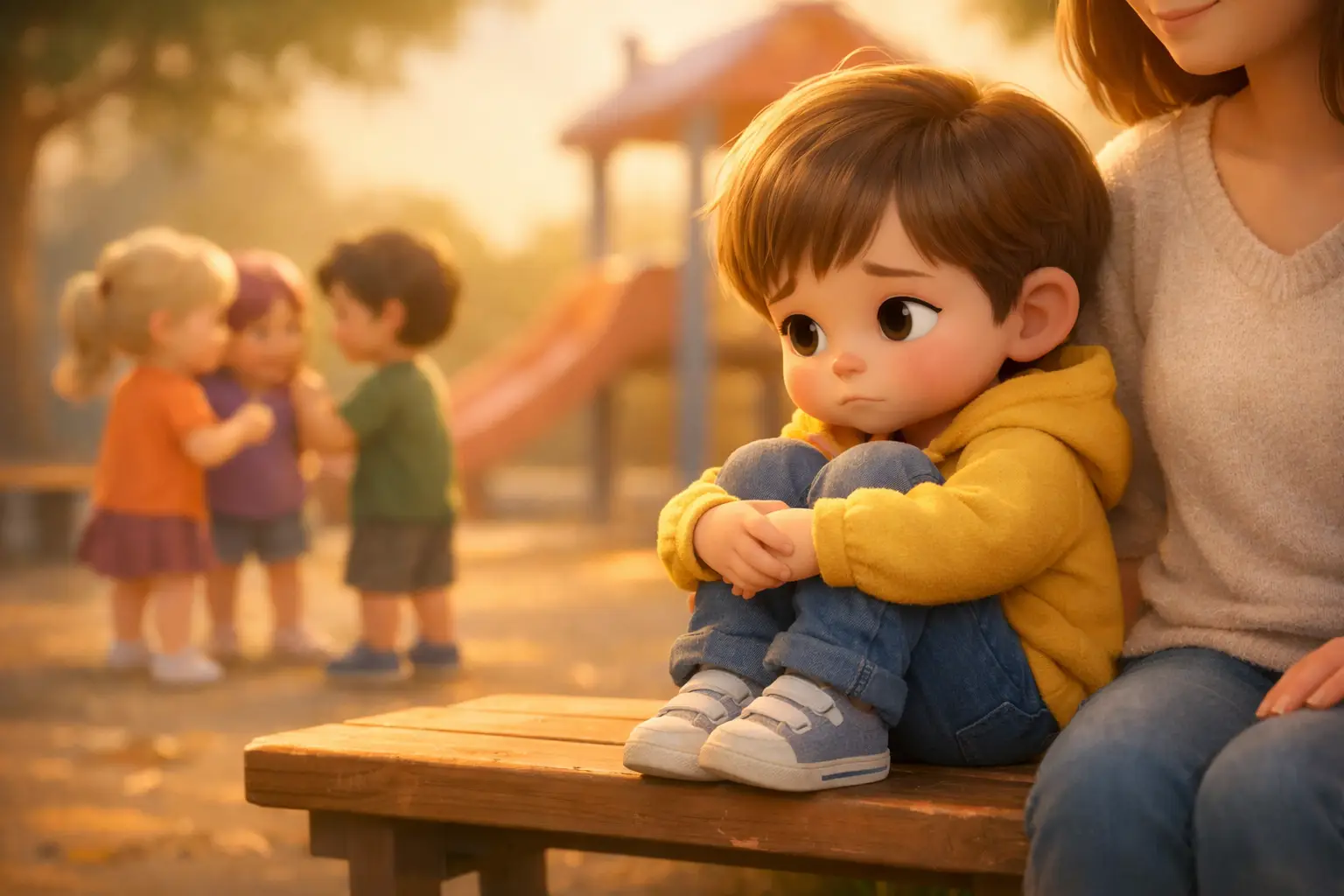
A child may not say, “I felt excluded at preschool today.” They may say, “Nobody played with me,” go quiet after a playdate, or suddenly insist they do not want to go back tomorrow. Stories about feeling left out give young children a safe, gentle way to recognize that tender feeling before they have all the words for it.
For children ages 3 to 6, being left out can feel very big. A game may already be full. Two friends may be deep in pretend play. A child may watch from the edge of the room and wonder, Is there a place for me? Even when no one meant to be unkind, the hurt is real.
A calm story cannot make every lonely moment disappear. What it can do is help a child feel less alone inside it. It can show that sad feelings are welcome, that friendship can be repaired or found in a new place, and that asking for help is a brave thing to do.
Why stories about feeling left out can help
Young children learn through pictures, repetition, and the small choices characters make. When a gentle character is not invited into a game, a child can watch from a safe distance. They can feel the disappointment without having to relive their own hard moment right away.
This little bit of space matters. A child who is overwhelmed may not be ready for questions about what happened at school. But they may be ready to say, “That bunny feels sad,” or, “I think the bear wants to play.” Through the character, children often begin to share what is true for them.
The most helpful stories do not rush to a cheerful ending. First, they let the character pause. Perhaps the small fox sits beneath a tree, holds a favorite pebble, or tells a caring grown-up, “I wanted to play too.” This sends a quiet but powerful message: hurt feelings do not need to be hidden or fixed immediately.
Then the story can offer a manageable next step. The character might ask, “Can I have a turn when you are done?” They might find another child who is also looking for a friend. Or they might choose a different activity with a teacher nearby. For preschoolers, these are not minor skills. They are early building blocks for connection and confidence.
What a comforting story should show
A story about exclusion works best when it feels true to a child’s everyday life. The problem does not need to be dramatic. In fact, a small, familiar moment is often more useful: a seat saved at the snack table, a game that has already started, or a child who cannot keep up with a fast-running group.
The character should be allowed to feel disappointed, lonely, angry, or confused. Children need to see that these feelings are normal. Saying “You can’t be sad” or “Just go play with someone else” may be meant kindly, but it can leave a child feeling unseen. A warmer message is, “That really hurt. You wanted to join.”
It also helps when stories avoid making one child the villain. Sometimes children do leave others out on purpose, and adults should address that with care. But often, young children are still learning to notice who is nearby, share control of play, and use welcoming words. A gentle story can make room for both truths: being excluded hurts, and other children may need help learning how to include.
Finally, a hopeful ending should feel earned. The answer is not always that everyone becomes best friends. The character may discover one kind classmate, enjoy time with a grown-up, or return to play another day with a new idea. The lasting comfort comes from this: “I can have a hard moment, and I am still lovable. I can try again with support.”
Small words children can borrow
One of the quiet gifts of stories is language. A child who has heard a character use a simple phrase may be more able to use it when they need it. Keep the words short, warm, and easy to remember.
A character might say, “Can I play too?” “What are you making?” or “Can I have a turn after you?” If the group is not ready to include them, the child can also learn another brave sentence: “I feel sad. Can you help me find something to do?”
These words are not magic. Some children will need an adult to say them alongside them at first. Some children may be too shy, tired, or upset to use them in the moment. That is okay. The goal is not perfect independence. The goal is to help children feel that they have choices and caring people beside them.
Reading together after a lonely day
When your child has had a difficult social moment, a story can be a softer doorway than direct advice. Choose a quiet time, perhaps after a snack, during a cuddle, or as part of bedtime. Read slowly enough for your child to notice the character’s face and body language.
You do not need to turn every page into a lesson. A few gentle observations are enough. You might say, “The little otter is standing by herself. I wonder what she is feeling.” Then pause. If your child wants to talk, listen without trying to solve everything at once.
If they share a similar experience, reflect it back simply: “You wanted to be in that game, and it felt lonely when there was no space.” Naming the experience can make it feel smaller and more understandable. It also tells your child that their feelings will not scare you away.
After that, you can wonder together about what might help the character. “Who could the otter talk to?” “What else might feel good right now?” The answer may be to ask a teacher, invite one friend to draw, or take a quiet break. Let your child’s idea count, even if it is different from the solution you expected.
When the story needs an adult beside it
Stories are a loving support, but they are not meant to carry the whole weight of a repeated problem. If your child often says they have no one to play with, seems frightened of school, withdraws from activities they once enjoyed, or comes home upset day after day, it may help to speak with their teacher or caregiver.
Share specific details without assuming the worst. Ask what they notice during free play, transitions, and group activities. A teacher may see patterns that are hard for a child to explain: perhaps your child needs help entering busy play, feels more comfortable with one friend at a time, or is being overlooked during a particular routine.
The right support depends on the child. Some children benefit from practicing a joining phrase at home. Others need a teacher to gently make space in the moment. A sensitive child may also need extra time to watch before stepping into a group. There is no single correct pace for friendship.
Gentle lessons that stay with children
The stories children remember are often not the ones with the biggest adventures. They are the ones that make a small feeling feel understood. A quiet character who finds a kind hand, uses a brave sentence, or learns that a lonely afternoon can change may stay with a child long after the book is closed.
At Cozy Pebble Stories, we believe children deserve stories that make room for the tender parts of growing up. Feeling left out is painful, but it is not proof that a child does not belong. With patient listening, caring guidance, and comforting stories, children can learn a steady truth: there is room for their feelings, their voice, and their place in the world.