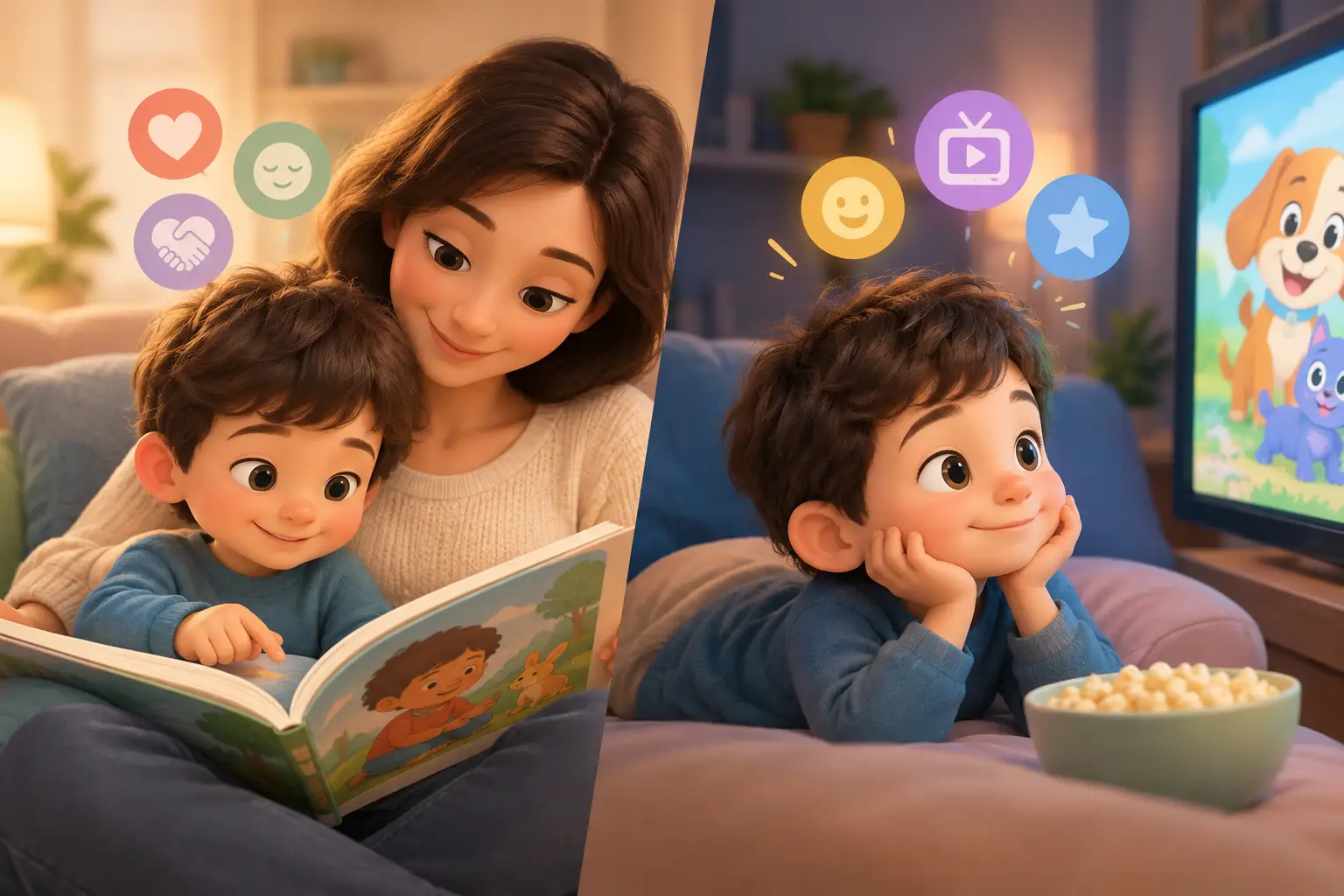
A child who has just shouted, cried, or hidden behind your leg does not need a perfect lesson. They need a safe way to understand what happened inside them. That is where social emotional books vs cartoons becomes a useful question for families. Both can help young children name feelings, see kindness in action, and practice brave little choices. But they do not ask the same thing of a child, and they do not fit every moment in the same way.
For children ages 3 to 6, the best choice is often less about which format is “better” and more about what your child needs right now. A quiet book can make room for a worried feeling. A gentle cartoon can show a facial expression, a caring voice, or a friendship repair in motion. When the story is calm, age-appropriate, and repeated with love, either one can become part of a child’s emotional toolkit.
Social Emotional Books vs Cartoons: The Real Difference
Picture books invite children to slow down. The page stays still while they notice a character’s drooping ears, a rumpled blanket, or a friend waiting nearby. There is time to pause and ask, “Have you ever felt that way?” There is time for a child to point, turn back, or sit quietly in your lap without needing to keep up with the story.
Cartoons bring other strengths. Young children can hear the wobble in a nervous voice, watch a character take a breath, and see how a misunderstanding changes when someone says, “I’m sorry.” Movement and music can make an emotional idea easier to remember, especially for children who learn through sound, rhythm, and imitation.
The trade-off is pace. Even a gentle animated story moves forward on its own. A child may absorb the feeling of a scene without having much time to reflect on it. Books naturally leave more space for conversation because a caring adult controls the speed. Cartoons can still be deeply supportive, but they work best when they are short, calm, and shared rather than used as background noise.
When a Book Is the Kinder Choice
A social-emotional picture book is especially helpful when your child needs closeness or when a feeling is still tender. Bedtime worries, a hard preschool drop-off, jealousy over a sibling, or a mistake that brought tears may all feel easier to approach through a character in a book.
Reading together creates a small, dependable ritual. Your child knows the pages, the pictures, and perhaps even the words. That repetition is not boring to young children. It is reassuring. Each rereading says, in a quiet way, “This feeling has a shape. We have met it before. We can get through it again.”
Books are also wonderful for children who become overstimulated easily. A watercolor illustration, a gentle rhythm of language, and the warmth of being held can settle a busy nervous system. If your child tends to become more excitable, irritable, or restless after screens, a book may offer the emotional lesson without adding extra sensory input.
A book does not need to name every skill directly to be useful. A story about a small fox afraid of the dark can open a conversation about fear. A bear who accidentally knocks down a friend’s block tower can help a child think about repair. The character gives children a little distance from their own experience, which can make hard feelings safer to discuss.
When a Cartoon Can Be a Gentle Helper
A well-made cartoon can meet children where their attention already is. For a preschooler, seeing a character’s body relax after taking three slow breaths may be more concrete than hearing an adult explain calming strategies. A song about waiting, sharing, or trying again can stay with a child long after the screen is off.
Cartoons are particularly useful when a child benefits from watching social moments unfold. They can show the small details that books sometimes leave to the imagination: a friend noticing someone is left out, a character asking before joining a game, or two children finding words after an argument. These scenes give children scripts they can borrow in real life.
The key is choosing stories that respect a young child’s developing attention and emotions. Gentle pacing, simple plots, warm voices, and clear resolutions matter. A show that is labeled educational can still be loud, frantic, or filled with jokes that race past the emotional message. If a child finishes watching more wound up than comforted, the format or program may not be the right fit for that time of day.
It also helps to watch with your child when possible. You do not need to turn every episode into a lesson. A few soft words are enough: “She looked disappointed when the game changed.” Or, “He came back to help. That was kind.” These little observations help children connect what they see on screen to the feelings they know in their own bodies.
Let the Moment Choose the Format
Rather than making a permanent rule about books or cartoons, notice the rhythm of your child’s day. After a loud birthday party or a tiring afternoon, a familiar book may be the softer landing. During a morning when you need ten calm minutes together, a short, soothing animated story can be a caring choice.
Consider your child’s purpose, not only their preference. If they are asking to watch the same cartoon song about being brave, repetition may be helping them practice a feeling. If they are reaching for a book about monsters under the bed night after night, they may be working through a real worry. Children often return to stories because they are building emotional understanding, one familiar moment at a time.
Here are four simple ways to make either format more meaningful:
- Choose one feeling at a time, such as disappointment, shyness, anger, or worry.
- Pause briefly to name what the character might be feeling, without insisting that your child answer.
- Repeat favorite stories and songs. Familiarity helps emotional language take root.
- Bring one small idea into real life, such as taking a breath together or checking on a sad friend.
These practices matter more than whether the lesson arrived on paper or on a screen. A child learns emotional safety through repetition, relationship, and the experience of being understood.
What to Look For in Emotionally Supportive Media
Whether you choose a book or cartoon, look for stories where feelings are treated as normal. The goal is not to make sadness, anger, or fear disappear quickly. It is to show that feelings can be noticed, named, and carried with support.
Helpful stories give children manageable problems. A character may feel left out, make a mistake, lose something special, or worry about nighttime sounds. The challenge should feel real enough to matter but gentle enough that a young child can stay with it. By the end, the character does not need a magical fix. Often, the most comforting resolution is a friend, a grown-up, a kind choice, or the discovery that they can take one small brave step.
Be thoughtful about humor, too. Silly moments can be wonderful, but children should not learn that another character’s fear or embarrassment is something to laugh at. Look for warmth instead of mockery, cooperation instead of constant competition, and repair instead of punishment. These are the patterns children may begin to copy during play, at school, and at home.
A Gentle Routine That Uses Both
Books and cartoons do not have to compete for a place in family life. They can work beautifully together. A child might watch a short animated story about feeling nervous before a new activity, then read a related picture book at bedtime. The cartoon gives them a clear model. The book gives the feeling more room to settle.
You can also let your child lead with a simple choice: “Would you like a story we read together, or a calm show we watch together?” The word together matters. It reminds children that emotional learning is not something they have to do alone.
Cozy Pebble Stories is built around this same gentle idea: small stories, songs, and characters can make big feelings feel less lonely. The format may change, but the most lasting message stays simple. Feelings are welcome here, and help is close by.
Tonight, when your child reaches for a book or asks for a favorite cartoon, you do not have to find the perfect answer. Sit nearby. Notice the story with them. A familiar character, a calm voice, and your steady presence can make even a difficult feeling feel small enough to hold.