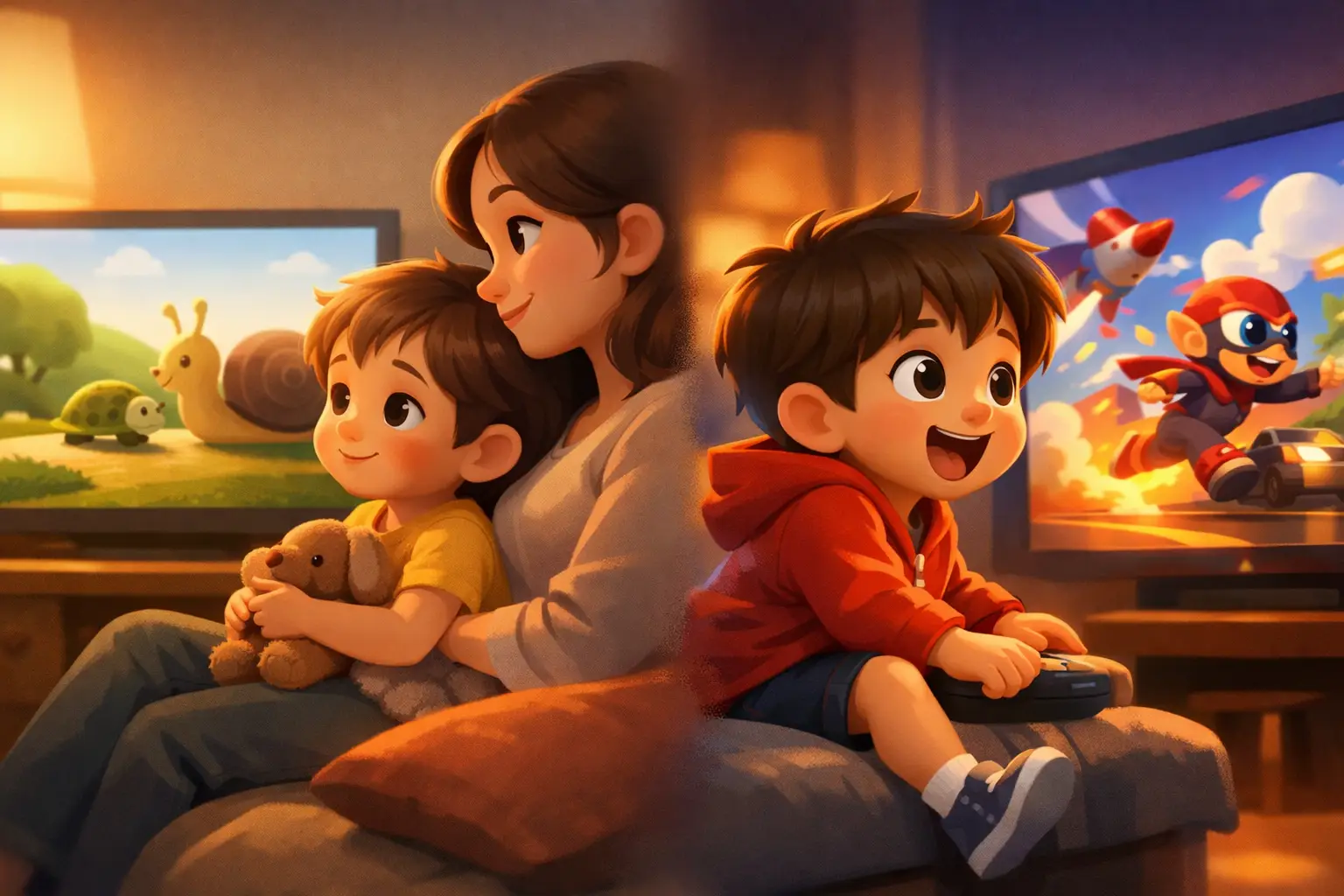
A cartoon ends, but your child is still moving. Their voice is louder, their body is busy, and the next small frustration suddenly feels enormous. Many parents recognize this moment. It can lead to a thoughtful question: when it comes to slow paced versus fast paced cartoons, does the speed of a show really affect a young child?
For children ages 3 to 6, the answer is often yes, though not in a simple good-or-bad way. Pace can shape how a child takes in a story, notices emotions, and settles after screen time. A quick, silly show may bring genuine laughter on a long car ride. A quieter story may be a better companion before preschool, after a hard day, or near bedtime.
The goal is not to make every screen experience perfectly calm. It is to choose media with the same care we bring to snacks, sleep, and the words we use when a child is feeling tender.
Slow Paced Versus Fast Paced Cartoons: What Changes?
Pacing is more than how quickly characters run or how many jokes appear in a minute. It includes how often the camera cuts, how loudly music changes, how much happens at once, and whether there is room for a child to understand what they are seeing.
Fast-paced cartoons often use rapid scene changes, bright visual movement, surprise sounds, energetic dialogue, and a problem that is quickly replaced by another problem. These features can be exciting. They can also ask a young child’s brain to keep shifting attention before it has had much time to rest, imagine, or make sense of a character’s feelings.
Slow-paced cartoons tend to hold a moment a little longer. A character might pause before speaking. The setting may be gentle rather than crowded. Music supports the feeling of the scene instead of pushing it forward. When a friend feels left out, worried, or proud, children have time to see the feeling on their face and hear what helps.
That pause has value. Preschoolers are still learning to name emotions, follow a simple sequence of events, and understand that another person may feel differently than they do. A calm story gives them a small, safe place to practice.
A slower story is not an empty story
Quiet does not have to mean dull. Children can be deeply engaged by a lost mitten, a rainy-day worry, a new friendship, or a brave first try. The action may be small, but the feeling is real.
In fact, stories with a clear emotional center can hold children’s attention in a different way. Instead of waiting for the next big surprise, they begin to wonder, Will the character be okay? What could help? Have I felt that way too? Those are meaningful questions for a young mind.
Why Fast Pacing Can Feel Big Afterward
Some children can watch an energetic cartoon and move on easily. Others seem more jumpy, impatient, or upset when the screen turns off. Sensitive children, children who are tired or hungry, and children already carrying a big feeling may find rapid media especially hard to leave behind.
This does not mean a fast show has harmed a child or that a parent has made a wrong choice. It simply means the child may need help with the transition. Their nervous system has been following a lot of movement, noise, and change. Returning to a quiet room, a waiting sibling, or the ordinary task of putting on shoes can feel like a sharp turn.
A child may not say, That was too stimulating for me. More often, they say it with their behavior. They ask for another episode with growing urgency. They struggle to switch activities. They become tearful over a small limit. These moments are information, not a reason for shame.
Fast-paced entertainment can still have a place. A cheerful, active song or a silly short episode may be welcome when a family needs a lift. The question is less about banning speed and more about matching the show to the moment and to the child in front of you.
What Calm Cartoons Can Offer Preschoolers
A gentle cartoon can support the rhythms many families are already trying to build: getting ready without rushing, recovering from disappointment, sharing space with others, and winding down at night.
Because the plot has breathing room, adults can join the experience without needing to decode a blur of events. You might ask, “That little bear looks nervous. What do you think would help?” A child does not need to answer. Even hearing the question shows them that feelings are worth noticing.
Slower stories also make repetition feel comforting instead of merely attention-grabbing. Young children often want the same book, song, or episode again because familiar words and endings help the world feel predictable. When the repeated message is kind - we can take a breath, friends can repair a mistake, worries can be shared - it becomes a phrase a child may carry into real life.
This is the heart of emotionally supportive media. It does not promise children that hard feelings will disappear. It shows them that feelings can be named, met with care, and made smaller with time, help, and connection.
How to Choose Between Cartoon Paces
There is no single pace that works for every child or every day. A useful place to start is noticing what happens before, during, and after a show.
Before watching, consider the time of day. A high-energy cartoon right before bed may make settling harder for some children, while a warm, predictable story can become part of a peaceful bedtime routine. After school or preschool, a child who has worked hard to listen, share, and follow directions may benefit from less noise and fewer demands.
During the show, listen for the emotional texture. Are characters mostly shouting, chasing, competing, or reacting to surprises? Or do they speak with care, solve small problems, and have moments of stillness? Neither style must be rejected automatically, but the second is usually easier for a young child to process.
Afterward, watch the transition. If your child is able to turn off the screen, play quietly, talk about the story, or move into the next routine with support, the pace may be working well. If endings regularly lead to distress, try a shorter episode, a calmer choice, or a screen-free activity afterward.
For many families, it helps to create a soft landing after any show. Offer a drink of water, a cuddle, a familiar song, or a simple invitation such as, “Let’s help your body get ready for the next thing.” This is not a punishment for watching. It is a kind bridge between one activity and another.
Look Beyond the Speed of the Screen
A slow show is not automatically supportive, and a fast show is not automatically unkind. A program can move gently while relying on teasing, scary conflict, or messages that do not fit a family’s values. Another may have an upbeat moment while still modeling friendship and repair.
When choosing cartoons for ages 3 to 6, look at the whole experience. Are the characters treated with respect? Is the problem manageable? Does the story make room for empathy? Are mistakes followed by repair rather than ridicule? Is the ending reassuring without pretending that every feeling is easy?
At Cozy Pebble Stories, those questions guide the kinds of stories we believe children deserve: soft places to meet a worry, practice courage, and remember that they do not have to handle every big feeling alone.
Let Your Child’s Response Be Part of the Answer
Parents do not need to measure every scene or feel guilty about every episode. Children’s needs change from day to day, and family life is full. Sometimes a familiar cartoon helps while dinner is being made. Sometimes a lively song turns a difficult morning around.
Still, when you can choose, calm and character-led stories offer something precious: time. Time for a child to notice a face, understand a feeling, and settle into the safety of a gentle ending. A story does not have to rush to be memorable. Sometimes the quietest moments are the ones a child brings back to you later, when they need a little courage, a little comfort, or a hand to hold.