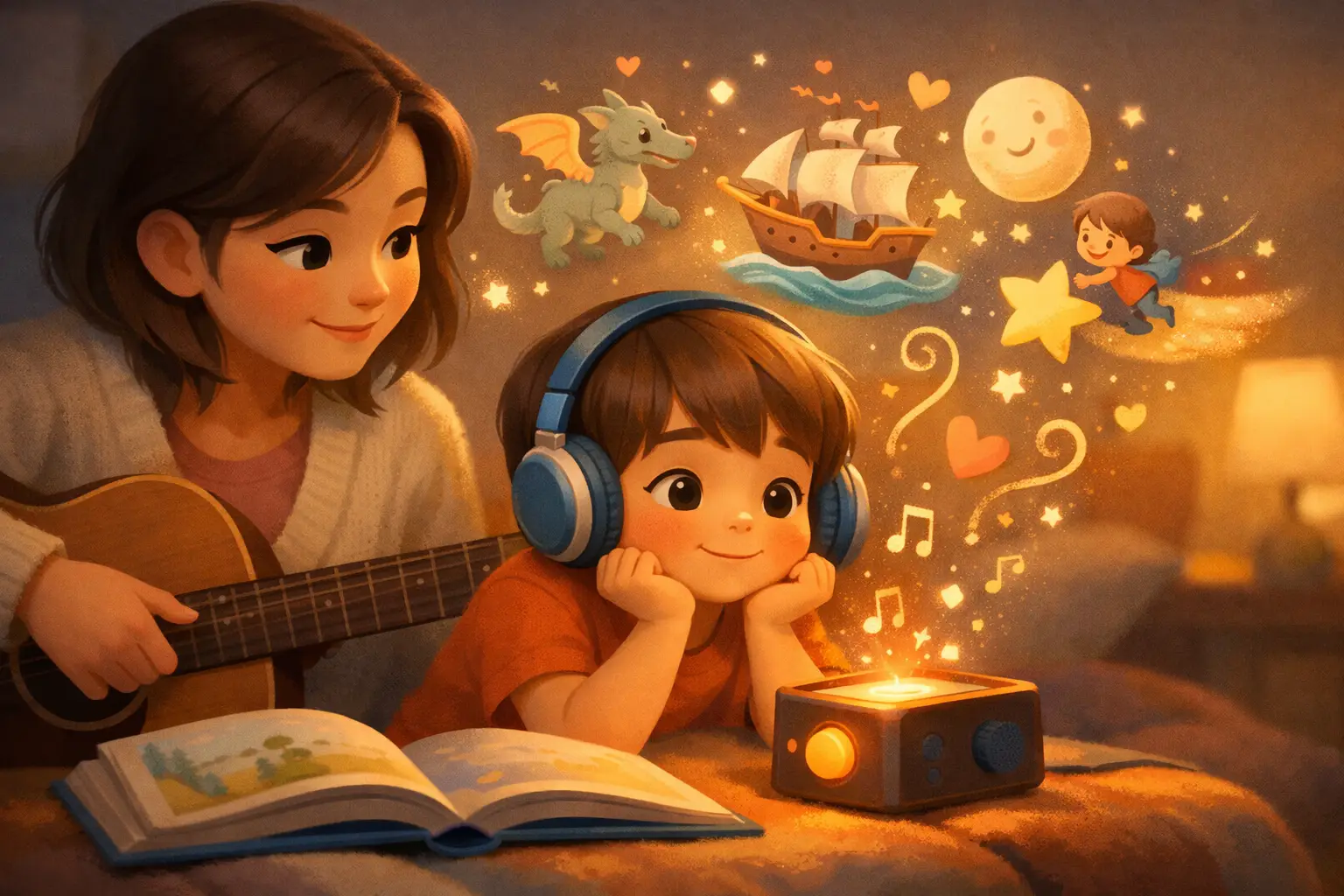
A child who cannot yet explain, “I am worried about tomorrow,” may sing about a little bunny with a fluttery tummy all afternoon. That is not just play. It is a safe way of saying something real. Learning how to use story songs gives parents and caregivers a gentle tool for helping young children notice feelings, feel understood, and practice what to do next.
For children ages 3 to 6, music and stories belong naturally together. A simple character, a familiar melody, and a repeated line can make an overwhelming feeling feel smaller. The goal is not to make a child cheerful right away. It is to offer comfort, language, and connection while they move through what they feel.
Why story songs can reach children so gently
A story song has a beginning, a small problem or feeling, and a comforting path forward. Perhaps a bear is nervous to join a game. Perhaps a fox misses Dad at bedtime. Perhaps a tiny bird makes a mistake and learns that a loving friend can help.
Unlike a direct question such as, “Why are you upset?” a song lets a child stand beside the character first. They can listen without feeling put on the spot. Later, they may point to the character’s feeling, repeat the chorus, or share a little about their own experience.
Repetition is part of the comfort. When the same gentle words return, children begin to hold onto them: “I can take a breath,” “I can ask for help,” or “I can try again.” Those phrases may not solve every hard moment, but they give a young child something steady to remember.
Story songs are especially helpful when the music is calm enough to leave room for the story. Fast, noisy music can be fun, but it may not be the right fit when a child is tired, worried, or already overwhelmed. Match the song to the moment rather than expecting one song to work for every feeling.
How to use story songs in everyday moments
You do not need a special lesson plan. The most meaningful use often happens in small, ordinary pockets of the day. Keep the experience simple, and let your child lead the pace.
Start with listening, not teaching
Choose a story song with one clear emotional idea. Listen together in the car, during quiet play, or while settling in after preschool. At first, simply enjoy it. Children are more likely to connect with the message when they are not being asked to perform understanding.
You might say, “That little raccoon felt shy when everyone was playing,” or, “I noticed the song got softer when the character took a breath.” Then pause. A child may have something to say, or they may just keep listening. Both responses are welcome.
If your child asks to hear the same song again and again, that is often a sign that it is doing important work. Repetition helps young children rehearse an emotional idea until it feels familiar. There is no need to rush them toward a new lesson.
Name the feeling through the character
When a child is calm, use the character as a gentle bridge. Instead of asking, “Are you scared of the dark?” try, “Do you think the little owl felt scared when the room was dark?” This gives your child room to answer without feeling exposed.
If they say yes, you can add, “Sometimes dark rooms can feel big. The owl found a small light and stayed close to someone safe.” Keep the connection light. The point is not to turn every song into a serious conversation. It is to show that feelings can be named and met with care.
Children may identify with a character one day and not the next. That is okay. Emotional learning is not a straight line. A child who says, “I’m not scared,” may still benefit from hearing that scared characters are loved and supported.
Add one small action to the song’s message
Songs become more useful when children can connect the story to a simple action. If a character in the song takes slow breaths, practice one or two breaths together. If the character asks a friend to play, try the words during pretend play: “Can I play too?”
Keep the action manageable. A preschooler does not need a long list of coping skills in the middle of a hard feeling. One familiar step is enough: hold a stuffed animal, ask for a hug, take a breath, find a grown-up, or try again.
It also helps to avoid using a song as a command. “Listen to your calm-down song” can feel dismissive when a child is crying. Try, “Would it help if we listened to the song about the bear who had big mad feelings? I can stay with you.” The music is an invitation, not a way to hurry a child past their emotion.
Make songs part of predictable routines
A story song becomes especially comforting when it appears in a routine your child can count on. Predictability helps children feel safe, particularly around transitions that can bring up worry or resistance.
Consider using a different kind of song for a few tender parts of the day:
- A cheerful, gentle song before preschool or daycare can support separation and confidence.
- A friendship song after a difficult playdate can open a conversation about sharing, waiting, or repair.
- A quiet song after bath time can help slow the pace before bed.
- A courage song before a new experience, such as a haircut or doctor visit, can offer a familiar emotional anchor.
The best routine is one you can keep. A two-minute song while putting on pajamas may be more powerful than an elaborate activity that only happens once.
Let children bring the story to life
After listening, invite your child to play with the story in an easy, low-pressure way. They might use stuffed animals to act out the song, draw the character’s brave moment, or make up a new verse together. You do not need to correct the story or guide it toward a perfect lesson.
Pretend play can reveal what a child is working through. A child may have the worried character hide under a blanket five times before the character is ready to come out. Stay nearby and follow their lead. You can offer gentle language such as, “The bunny wants to be close,” or, “The bunny is taking their time.”
Making up a verse can be especially helpful after a real-life challenge. If your child had trouble saying goodbye that morning, you might sing, “The little fox waved, then felt a squeeze inside.” Let your child choose what happens next. Maybe the fox holds a grown-up’s hand, carries a familiar pebble, or remembers that pickup comes after snack. Their answer can show you what support feels meaningful to them.
Use story songs for connection, not perfection
There will be days when your child does not want to talk, sing, breathe, or listen. On those days, your calm presence matters more than any message in a song. Sit close if they want closeness. Give space if they need it. Let the song wait.
Story songs are not meant to erase sadness, anger, jealousy, or fear. Those feelings are part of being human, even when they arrive in very small bodies with very big voices. The gentle purpose of a song is to help a child learn, “My feelings make sense. I am not alone. There is a next step when I am ready.”
At Cozy Pebble Stories, we believe small, repeatable moments of comfort can stay with children long after the music ends. A familiar chorus heard in a safe lap, a character who finds courage slowly, or a shared whisper before sleep can become part of the inner voice your child carries forward.
The next time a big feeling arrives, you do not need to find perfect words. Put on a gentle story song, stay close, and let your child know that every feeling has room to be heard.