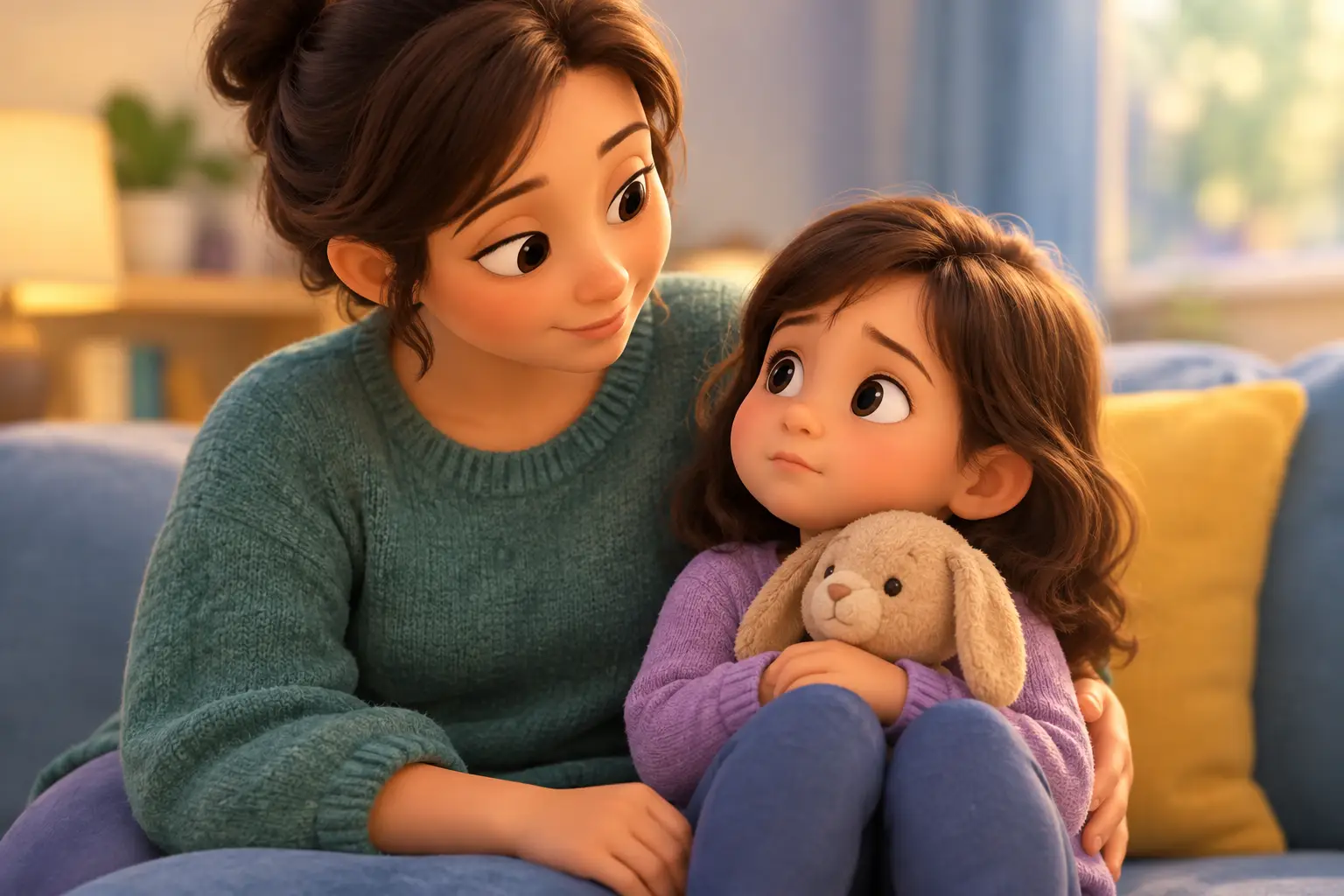
A child can be surrounded by people and still feel alone. It might happen at preschool when the game has already begun, at a busy family gathering, or at bedtime when the room feels especially quiet. Learning how to talk about loneliness gives children a gentle way to name that feeling and learn that they do not have to carry it by themselves.
For children ages 3 to 6, loneliness may not sound like, “I feel lonely.” It may show up as tears over a small disappointment, extra clinginess, frustration with a sibling, or a quiet refusal to join in. The goal is not to quickly make the feeling disappear. It is to help your child feel seen, safe, and connected while they move through it.
Start by making the feeling feel allowed
When a child says nobody wants to play with them, it can be tempting to jump straight into reassurance. “That is not true,” or “You will make friends tomorrow,” comes from love. But when children are hurting, they often need comfort before solutions.
Try slowing down and reflecting what you notice. You might say, “It sounds like you really wanted someone to play with you today,” or, “Being left out can feel very sad.” These simple words tell your child that their feelings make sense.
You do not need to agree with every detail to validate the emotion. Perhaps another child was not trying to exclude them, or perhaps your child had only just arrived at the game. You can gently explore that later. In the tender first moment, let the feeling have a place to land.
For young children, it can help to describe loneliness in body-sized language. “Lonely can feel like a little empty spot in your chest,” you could say. “Sometimes it makes us wish for a friend or a grown-up to be close.” This gives a child a picture for something that can otherwise feel confusing and too big.
How to talk about loneliness in simple, honest words
Children do best with language they can borrow and use again. Keep your explanations short, warm, and clear. Loneliness is not a bad behavior, and it does not mean there is anything wrong with your child.
You might say:
“Loneliness is a feeling we can have when we wish we were closer to someone.”
“Lots of people feel lonely sometimes, even grown-ups.”
“Feeling lonely does not mean you will be lonely forever.”
“I am here with you. We can think of one small way to feel more connected.”
That last sentence matters because it holds both comfort and hope. It does not promise that every social moment will go perfectly. Instead, it reminds your child that connection can be built in small, manageable ways.
Avoid turning loneliness into a lesson too quickly. A child who has had a hard day may not be ready to practice sharing, taking turns, or introducing themselves. First comes closeness. Later, when they are calm, you can help them rehearse a simple friendship skill.
Listen for what your child means by alone
The word alone can mean different things to a preschooler. One child may mean, “My best friend played with somebody else.” Another may mean, “I wanted you when you were making dinner.” A third may be feeling overwhelmed and actually need a little quiet time, not more company.
Gentle questions can help you understand the story underneath the feeling. Try asking, “When did the lonely feeling come?” “What happened right before that?” or “Did you wish someone would sit with you?” Ask one question at a time, then leave room for silence. Young children often need a moment to find their words.
If your child cannot explain, that is okay. You can offer choices without pressing for an answer: “Was it more like missing me, missing a friend, or feeling left out?” A shrug or a nod may be all they can give you that day.
Sometimes children will share more easily while their hands are busy. Talk during a walk, while coloring, in the bath, or while tucking stuffed animals into bed. Eye contact can feel intense when a child is sad. Side-by-side moments often make room for more honest conversation.
Use stories and pretend play to make room for feelings
A child may not want to talk about their own loneliness directly. But they may be very ready to talk about a little fox who cannot find anyone to sit beside, or a bear who hears laughter from across the playground and feels left out.
Stories give children a safe bit of distance. You can pause and wonder together: “How do you think the bear feels?” “What might help the fox feel less alone?” “Who could notice?” There is no need to steer every answer. Let your child lead when they can.
Pretend play works in a similar way. A few toy animals, blocks, or paper figures can become a small social world. One character can ask, “Can I play too?” Another can make space at the table. Your child is not being tested. They are practicing possibilities through play.
Songs and repeated phrases can also be wonderfully comforting. A simple line such as, “When I feel alone, I can find a caring voice,” may be easier for a young child to remember than a long conversation. Gentle stories, music, and familiar characters can make emotional words feel like friendly tools rather than heavy topics.
Help your child take one small step toward connection
Loneliness often asks for connection, but that does not always mean a child needs a big playdate or a crowded activity. For a sensitive child, more social time can feel tiring if it is rushed or unfamiliar. Think small and specific.
At home, connection might mean reading one book together under a blanket, helping stir dinner, calling a grandparent, or inviting a sibling to build a block tower. At school, it might mean practicing one simple sentence: “Can I play?” or “Do you want to build with me?”
It helps to rehearse these words when your child is feeling steady, not in the middle of a tearful moment. You can take turns being the child who asks and the friend who answers. Include more than one possible response. A friend may say yes, may be busy, or may not hear right away. Your child can learn that a no is disappointing, but it is not proof that they do not belong.
You can also talk with your child’s teacher if loneliness seems to come up often at school. Share what your child has said without labeling them as shy or lonely. A teacher may be able to notice quieter moments, pair your child with a kind classmate, or help them enter a game with support.
Let children see that connection can be repaired
Even loving families have moments when someone feels missed, unheard, or left out. These small ruptures are not failures. When they are repaired with care, they teach children that relationships can bend and still feel safe.
If you were busy and your child felt alone, you might say, “You wanted me to play, and I was finishing something. That felt hard. I am ready to be with you now.” If siblings leave one another out, help them name what happened and make room for a repair without forcing instant closeness.
Children learn from watching adults reach out, too. You can quietly model it: sending a kind message to a friend, checking on a neighbor, or saying, “I missed talking with you.” This shows that asking for connection is a strong and ordinary thing to do.
When loneliness needs extra support
A lonely day, a rocky friendship, or a hard transition is part of growing up. Still, pay attention if your child seems persistently sad, avoids activities they once enjoyed, has frequent physical complaints around school, or seems unusually fearful about being apart from you. Changes in sleep, eating, or play can also be worth noticing.
These signs do not automatically mean something is seriously wrong. They are simply an invitation to get curious. Talk with your child’s pediatrician, teacher, or a qualified child mental health professional if the feeling is lasting, intense, or getting in the way of daily life. Asking for support is another way of showing a child that no one has to face a hard feeling alone.
When your child tells you about loneliness, you do not need a perfect answer. Sit close. Name what hurts. Offer one small thread of connection. Over time, those quiet moments teach a lasting lesson: feelings may come and go, but caring people can help us find our way back to one another.