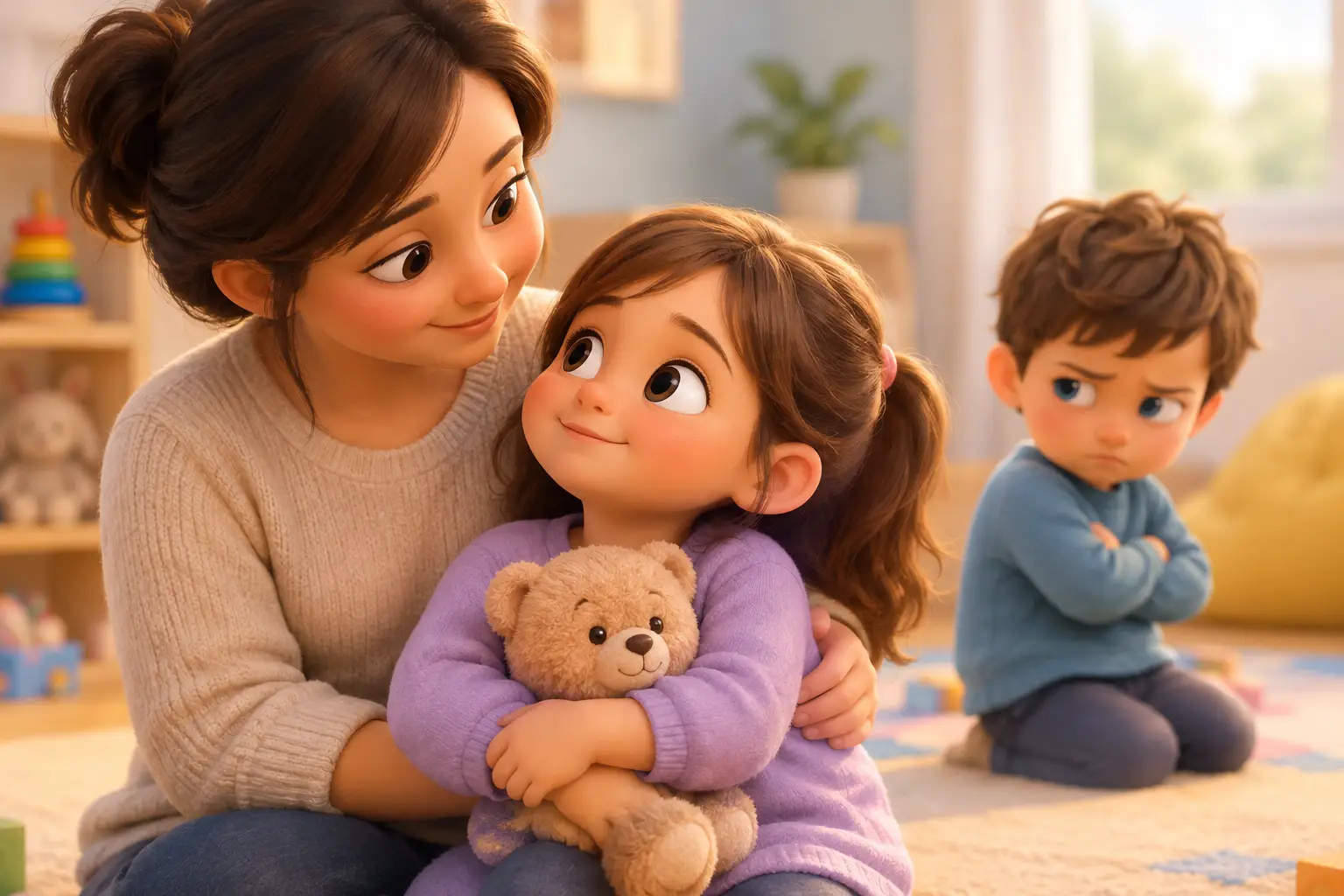
The hard moment may arrive when you are holding a new baby, praising a sibling’s drawing, or chatting with another parent at pickup. Your preschooler suddenly clings, whines, grabs, or says something startling like, “I don’t like the baby.” Learning to handle preschool jealousy begins by seeing the need beneath the behavior: your child is asking, in the only way they know, “Do I still belong with you?”
Jealousy can feel uncomfortable for adults to hear, especially when it comes out as a shove, a hurtful word, or a demand for all your attention. But it is not proof that your child is unkind or ungrateful. For children ages 3 to 6, love can still seem like a small, precious thing that might run out. With calm guidance, they can learn a gentler truth: someone else being loved, noticed, or praised does not make them less loved.
Why preschool jealousy can feel so big
Preschoolers are learning to share toys, turns, spaces, and trusted adults. They are also still developing the language and self-control to manage disappointment. When a friend gets picked first for a game, a sibling receives a birthday gift, or a baby needs feeding again, jealousy may rush in faster than words can.
This feeling often shows up during changes. A new sibling, a move, a new classroom, a caregiver returning to work, or even a busy holiday season can make a child wonder where they fit. Sometimes jealousy is quieter: a child becomes extra clingy, suddenly insists they cannot do something alone, or tears up another child’s creation.
There is no need to label your child “jealous” as though it is who they are. Instead, name what you see with softness. You might say, “You wanted my lap when I was holding the baby,” or, “It was hard to watch Maya get a turn with the sparkly truck.” A named feeling is often a little less frightening.
How to handle preschool jealousy in the moment
When jealousy spills into unsafe behavior, begin with safety and steadiness. Move close, block a hitting hand, separate children if needed, and use a low, clear voice: “I won’t let you hit. You are very upset, and I will help you.”
Try not to lecture while your child is flooded with emotion. Long explanations can feel like more noise when a child is already overwhelmed. First, offer the simple boundary. Then offer connection. Once their body has softened and their breathing is slower, you can help put the moment into words.
A helpful pattern is to hold both the feeling and the limit:
“You really wanted me to look at your picture too. It hurts to wait. I won’t let you rip your brother’s picture. Let’s place it on the table, and then you can show me yours.”
This does not excuse the behavior. It teaches that every feeling is welcome, while not every action is okay. That distinction gives children a safe place to grow.
Avoid forcing an immediate apology when your child is still angry or tearful. A rushed “sorry” may quiet the room without repairing anything inside. Later, when they are calm, guide a small repair: bringing a tissue, helping rebuild blocks, checking whether a sibling is okay, or practicing a kinder sentence. Repair is a skill, and skills take practice.
Give the feeling words your child can borrow
Young children often need a parent’s words before they can find their own. Keep the language short enough to remember. You might say, “Part of you wishes that were your turn,” or, “You wanted to be the special helper today.”
It can also help to gently separate wishing from blaming. “You wish you had the red cup. It is okay to wish. Your sister did not do anything wrong by having it.” This makes room for disappointment without turning another child into the problem.
For a child who is ready, offer a few simple phrases to practice during calm moments:
“I want a turn when you are done.”
“Can I have some cuddles after the baby eats?”
“I feel left out. Can I play too?”
“I am happy for you, and I want a turn later.”
Children rarely use these words perfectly at first. They may still cry, stomp, or forget. That is normal. Repeating the same gentle language helps it become familiar enough to reach for when feelings grow large.
Create small moments of belonging
Jealousy is not always solved by giving equal amounts of everything. Children notice when fairness becomes a scoreboard, and family life cannot always be perfectly even. A baby may need more physical care. An older sibling may have a later bedtime. A child who is sick may need extra comfort.
What helps most is reliable belonging. Let each child know, in words and in ordinary routines, that their place is secure. A predictable five-minute cuddle before bedtime, a silly song while buckling the car seat, or a regular walk to check the mail together can matter more than a grand outing.
Try to describe what is special about your relationship without comparing children. Instead of, “You’re my big helper, unlike the baby,” say, “I love how you notice tiny details when we read together.” Instead of, “Your sister is better at sharing,” say, “You kept trying to find a way for both of you to play.”
Specific attention tells a child, “I see you.” It also avoids placing one sibling in a role that can become heavy. The “big helper” role can be lovely when it is optional, but it should not mean a child must give up their own need for comfort, play, or help.
Prepare for the moments that tend to sting
A little preparation can make jealousy easier to carry. Before a playdate, birthday party, or visit with a new baby, talk through what may happen. Keep it simple and honest: “Grandma may hold the baby for a while. I will still have a hello hug for you, and later you can help me choose a book for us to read.”
At preschool, children may feel jealous when a teacher gives attention to someone else. You can practice at home with stuffed animals. Let one animal receive a pretend sticker or compliment, then help your child respond. “Bunny feels left out. What could Bunny say?” Play offers enough distance for a child to explore a difficult feeling without being in trouble for having it.
Stories can help, too. A gentle picture book or quiet story about a character who feels left out gives children a safe way to say, “That is how I feel sometimes.” Pause after the character’s big feeling and wonder together: “What do you think they needed?” There is no need to turn every story into a lesson. Sometimes being understood is the lesson.
What not to say when a child is jealous
Even loving adults can reach for phrases that accidentally add shame. “Don’t be jealous” asks a child to stop feeling before they know how. “You should be happy for your sister” may be true eventually, but it can sound like there is no room for the hurt underneath.
Try to skip comparisons, too. Statements like “Your brother never acts this way” can deepen the fear of being less lovable. And be cautious about making your child responsible for a younger sibling’s happiness. They can participate in caring for a baby or help a friend, but their own childhood needs care as well.
If you lose patience, repair with your child. “I spoke too sharply. You were having a hard time, and I want to try that again.” This does not weaken your authority. It shows that relationships can bend, be tended, and feel safe again.
When jealousy needs extra support
Most preschool jealousy comes and goes as children gain language, confidence, and experience. Still, it may help to speak with your child’s pediatrician or a child mental health professional if aggression is frequent or severe, if your child seems persistently sad or withdrawn, or if family life feels tense most days.
Support can be especially useful after a major change or loss. Asking for help is not a sign that you have done anything wrong. It is another way of caring for your child’s tender inner world.
The next time your child reaches for you in a jealous moment, let your calm presence say what they most need to hear: “There is room for your big feeling. There is room for everyone here. And there is still plenty of love with your name on it.”