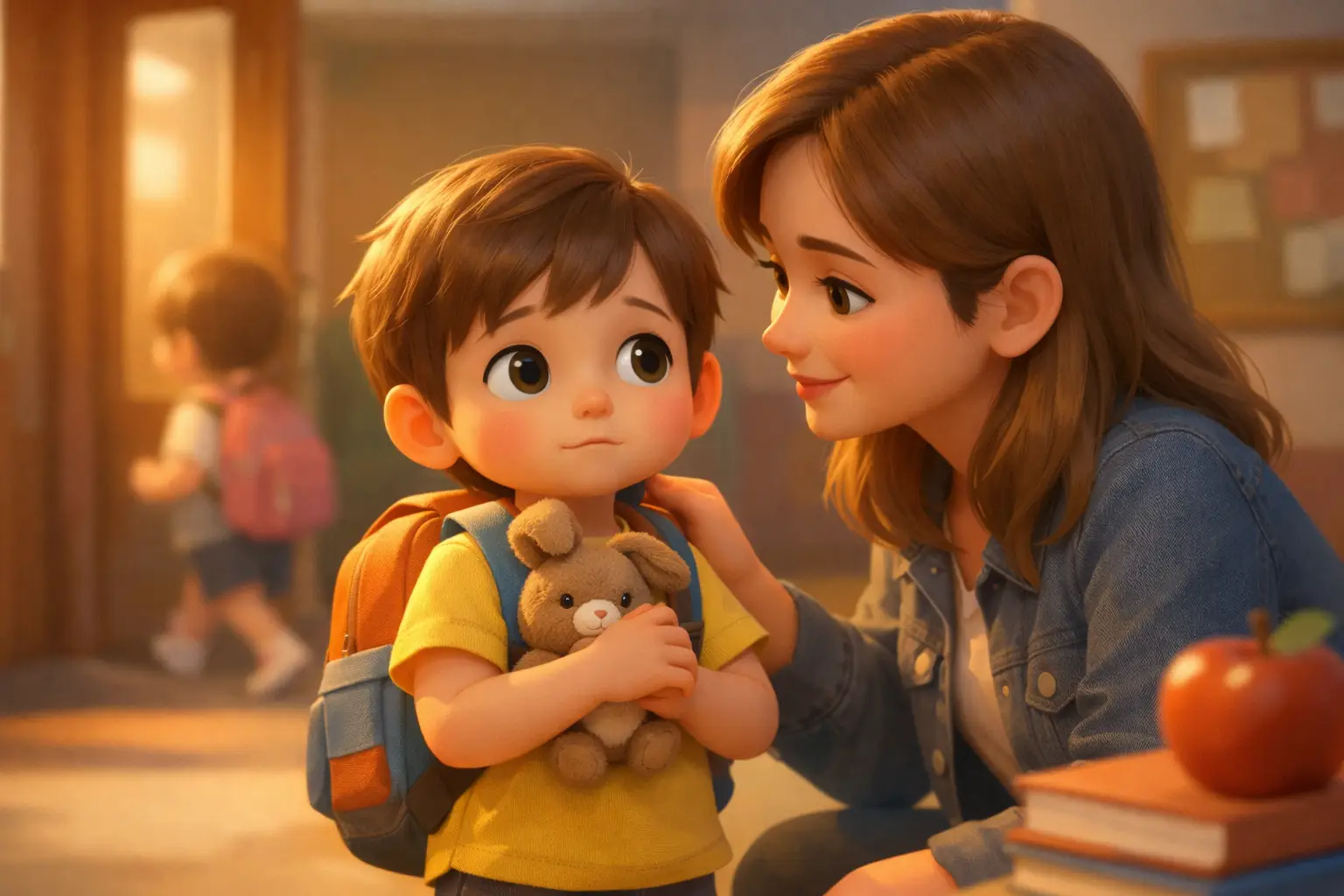
A new backpack can look very small beside a very big feeling. For a child who is starting preschool, kindergarten, a new classroom, or a new child care routine, stories for first day jitters can offer something wonderfully steady: a safe little place to meet the worry before the real morning arrives.
Children ages 3 to 6 often feel several things at once about a first day. They may be excited about paints, playgrounds, and new friends, while also wondering who will help them open their lunch, where you will be, or what happens if they miss home. Those feelings do not mean a child is not ready. They mean they are standing at the edge of something new.
A gentle story cannot make every goodbye easy, and it should not promise that the day will feel perfect. What it can do is help a child recognize a feeling, imagine a manageable next step, and remember that grown-ups come back. That is a powerful kind of comfort.
Why stories for first day jitters help
Young children learn through repetition, play, and pictures they can hold in their minds. When a story character feels nervous about school, a child can look at that feeling from a cozy distance. It is the bunny, bear, or small child in the book who has a fluttery tummy. Yet the child listening may quietly think, “That happens to me, too.”
This shared feeling matters. Instead of hearing, “Don’t be scared,” a child hears that nervousness is allowed. The character might take a slow breath, hold a familiar keepsake, ask a teacher for help, or find one kind thing in the room. These are small actions, but they give a child language and choices when their own words feel hard to find.
Stories also make the unknown more familiar. A first-day tale can gently show the rhythm of arrival, putting away a bag, meeting a teacher, playing, having a snack, and coming back together at pickup. For many children, the hardest part is not school itself. It is not knowing what comes next. A calm story gives the day a shape.
What makes a first-day story comforting
Not every school story will feel right for every child. Some children enjoy silly surprises and bustling classrooms. Sensitive children may need a quieter tale, one with soft illustrations, a patient pace, and a clear sense that the grown-ups are caring and capable.
Look for stories that let the main character have real feelings. A child may connect more deeply with a character who says, “I want to go, but I also want to stay close,” than with one who is cheerful from the first page. The goal is not to turn worry into happiness right away. The goal is to show that a worried child can still take the next small step.
The most helpful stories usually include a few reassuring anchors: a loving goodbye, a warm teacher or trusted adult, a simple coping tool, a moment of connection, and a reunion. These elements reflect what children need to know in real life. “I can feel nervous. Someone will help me. My family always comes back.”
A story with a dramatic conflict is not necessarily wrong, especially for a child who likes a little adventure. But in the days just before a first day, calmer is often kinder. Avoid choosing a story that makes separation sound frightening or turns a child’s worry into a joke. Children deserve stories that treat their feelings with respect.
The words children can borrow
The best phrases are short enough to use at the classroom door. After reading, try repeating one line together, such as: “My nervous feeling can come with me.” Or, “I can ask for help.” Or, “Goodbye means we will see each other later.”
Choose only one or two phrases. Too many reminders can feel like another big task. A simple sentence, repeated warmly, may become a bridge between home and school.
How to share stories for first day jitters
Read the story before the first day, but do not save it for one grand preparation night. Begin a few days ahead if you can, then return to it more than once. Familiar pages can become a small ritual when everything else feels new.
Read at a quiet time, perhaps after dinner or during a calm part of the bedtime routine. Let your child hold a comfort item, sit close, or turn the pages. There is no need to quiz them about every feeling. Gentle pauses leave room for children to speak when they are ready.
You might say, “This little fox has a wiggly feeling about school. Have you ever had a wiggly feeling?” If your child says no, that is okay. If they change the subject, that is okay too. Sometimes children listen carefully without wanting to talk yet.
When they do share a worry, meet it simply. “You wish I could stay all day. I understand. I will say goodbye, and your teacher will be with you. Then I will come back after school.” Try not to rush into solving every concern. First, let the feeling be heard.
It can also help to connect the book to the real plan. “Just like the character puts their coat in a cubby, we will hang your jacket up. Then we will find your teacher.” Be truthful about what will happen. A predictable goodbye is gentler than slipping away, even when tears are possible.
Bring the story into everyday play
For preschoolers, play is another kind of storytelling. After reading, set up a tiny pretend classroom with stuffed animals, blocks, or dolls. Let your child be the teacher, the parent, or the nervous student. You may hear their concern come out through a teddy bear who says, “What if my dad forgets me?”
Answer the teddy bear with calm confidence: “Dad always comes back after school.” Then let the child lead. They may want the bear to cry, hide, have a snack, or make a friend. There is no need to steer the play toward a perfectly happy ending. The point is to let the experience become familiar enough to handle.
A drawing can work in much the same way. Invite your child to draw one thing they hope to see at school and one thing that might help if they feel nervous. Perhaps it is a teacher’s hand, a water bottle, a favorite song, or a picture tucked into their bag. Keep the activity light. This is not a test of readiness.
When the first-day worry is bigger
Some children will listen to a story, practice the goodbye, and still cry at drop-off. Tears are communication, not proof that you made the wrong choice or that your child has failed at being brave. Many children settle soon after a caring, consistent goodbye, particularly once they can join a familiar activity.
It depends on the child, the setting, and the transition. A child who is new to group care may need more time than a child who has attended preschool before. A change at home, a poor night of sleep, or an unfamiliar classroom can make ordinary separation feel extra hard.
Share useful details with the teacher before the first day if possible. Let them know what comforts your child, what name they use for a favorite toy, and what words you plan to use at goodbye. A teacher cannot erase every feeling, but a prepared adult can offer a gentle hand at just the right moment.
If distress remains intense for many days, affects sleep or daily life, or does not ease once your child is with trusted caregivers, speak with the teacher and your child’s pediatrician. Asking for support is a caring next step, not an overreaction.
A small ritual for the classroom door
A brief goodbye ritual gives children something dependable to do when words are hard. It might be a hug, two kisses, a hand squeeze, and one familiar sentence. Keep it short and repeat it the same way each day. Long, uncertain goodbyes can accidentally make the moment feel more alarming.
You could say, “Hug, kiss, squeeze. I love you. Your teacher will help you. I will be back after school.” Then leave with a warm, confident face, even if your own heart feels tender. Children borrow our steadiness before they can fully make their own.
The first day does not need a fearless child. It only needs a child who feels safe enough to try, one small brave moment at a time. A comforting story, read close together, can remind them that nervous feelings may ride along - and that they never have to carry them alone.