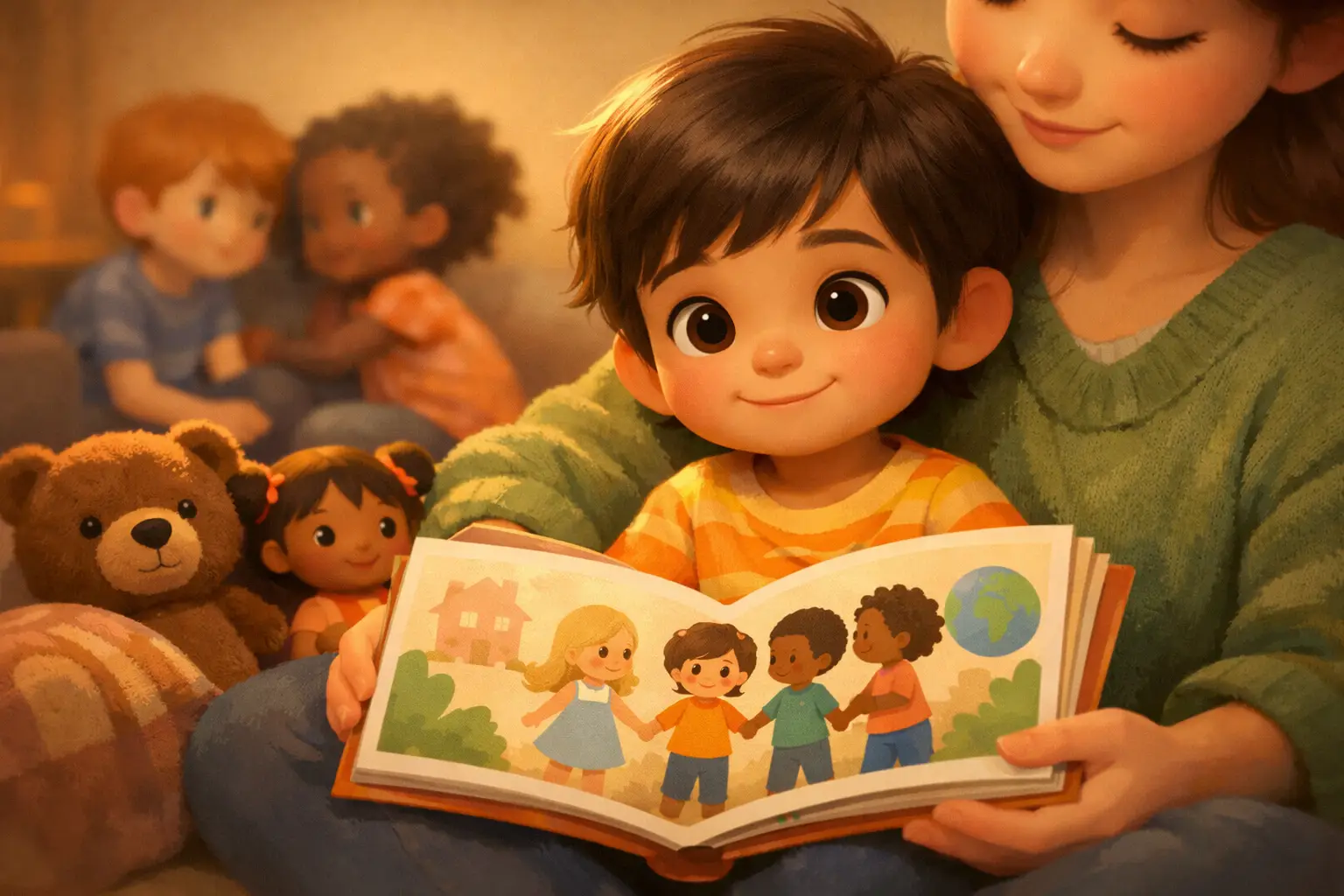
A child does not always say, “I feel left out.” Sometimes they grow quiet after preschool, hesitate before a birthday party, or ask if their family is like everyone else’s. A loving picture book can give those tender feelings a name. The best picture books about belonging help children see that there is room for their voice, their body, their family, their culture, and their big heart.
For ages 3 to 6, belonging stories work best when they feel safe rather than heavy. They offer a reassuring path: a child feels unsure, someone makes space, and connection becomes possible. The books below open gentle conversations about friendship, identity, classroom community, and being welcomed just as you are.
12 Best Picture Books About Belonging for Kids
The Day You Begin by Jacqueline Woodson, illustrated by Rafael López
This beautiful book understands the brave, wobbly feeling of entering a room where everyone seems different from you. Children share pieces of themselves, including foods, homes, languages, and family stories, and slowly discover that telling their story can create a bridge.
The message is especially comforting for a child starting a new school, moving, or feeling shy in a group. The language is a little more lyrical than some preschool books, so younger children may enjoy it best in small, cozy stretches. Pause to ask: What is something special about our family that you could share?
All Are Welcome by Alexandra Penfold, illustrated by Suzanne Kaufman
A school day unfolds with children and families of many backgrounds learning, playing, eating, and celebrating together. Its repeated reassurance that all are welcome gives young children a phrase they can carry into the classroom.
This is a warm choice for the first weeks of school or whenever your child needs a reminder that differences are part of a caring community. The busy illustrations offer plenty to notice, including varied abilities, religions, clothing, and family structures. You do not need to explain every detail. Let your child’s questions lead.
The Name Jar by Yangsook Choi
When Unhei moves from Korea to a new school, she worries that her classmates will not be able to say her name. A jar of possible names appears in the classroom, but Unhei eventually finds the courage to keep the name that belongs to her.
This story gently shows that belonging does not mean making yourself smaller or easier for others. It can be a helpful read for children learning classmates’ names, for families honoring a cultural heritage, and for any child who has felt different. Afterward, practice saying names slowly and kindly, including your child’s own name.
The Invisible Boy by Trudy Ludwig, illustrated by Patrice Barton
Brian is quiet, artistic, and often overlooked. He is not picked for games or included in birthday plans. Then a new classmate notices him, and one small act of friendship begins to change how Brian feels at school.
The Invisible Boy is tender without pretending exclusion does not hurt. It helps children recognize that someone can be nearby and still feel unseen. For sensitive children, this book can be a gentle doorway into talking about lunch tables, playtime, and ways to invite another child in. Its most hopeful lesson is wonderfully simple: noticing someone matters.
The Big Umbrella by Amy June Bates and Juniper Bates
The Big Umbrella has room for everyone who needs shelter from the rain. It does not worry about who looks different, takes up space, or arrives a little late. It simply opens wider.
Young children quickly understand the umbrella as a picture of inclusion. The idea is big, but the story remains playful and accessible. This is a lovely book for a classroom or family conversation about making room, whether that means sharing a toy, welcoming a new child, or listening when someone has a different idea.
Julian Is a Mermaid by Jessica Love
Julian sees three women dressed as mermaids on the subway and feels a spark of recognition. At home, he imagines himself with flowing hair, a bright crown, and a mermaid tail. His abuela’s response gives the story its deep, quiet warmth.
With very little text and expressive illustrations, this book affirms imaginative self-expression. It does not turn Julian into a lesson or ask him to defend who he is. It simply makes space for joy. Some families may use it to talk about clothes and play; others may connect it to a wider conversation about being yourself. Both are enough.
Sulwe by Lupita Nyong’o, illustrated by Vashti Harrison
Sulwe wishes her skin were lighter because she does not see her own deep, dark color reflected as beautiful. A nighttime journey helps her understand the wonder and value of the darkness she carries.
This is a meaningful story about colorism, self-love, and seeing beauty more fully. Because the feelings are tender and the ideas can be layered, it helps to read slowly and stay close to your child’s response. The book is not only for Black children. It also invites every child to learn that skin color deserves respect, appreciation, and care.
The Proudest Blue by Ibtihaj Muhammad with S. K. Ali, illustrated by Hatem Aly
On the first day of school, Faizah watches her older sister wear a blue hijab for the first time. When other children make unkind comments, Faizah sees her sister meet the moment with dignity and strength.
The Proudest Blue offers children a clear example of family support and pride in faith and identity. It also creates an age-appropriate opening to discuss what to do when someone says something unkind about another person’s clothes, traditions, or body. The loving bond between the sisters makes the story feel steady and safe.
A Family Is a Family Is a Family by Sara O’Leary, illustrated by Qin Leng
When a teacher asks the class to describe their families, children share many different answers. Some have two moms or two dads, some live with grandparents, some have foster families, and some families have a parent who lives elsewhere. Each child’s family is treated with warmth and respect.
For children, it can be deeply settling to see that there is no single right shape for a family. The book is especially helpful when your child is beginning school and noticing differences between homes. Read it with a simple truth in mind: families may look different, but love and care can be found in many places.
Lubna and Pebble by Wendy Meddour, illustrated by Daniel Egnéus
Lubna and her father arrive in a new place with very little, and she finds comfort in a small pebble. When a younger boy needs that comfort even more, Lubna faces a tender choice about sharing what helps her feel safe.
This story touches on displacement and refugee experiences with gentleness and dignity. It may bring up thoughtful questions about homes, safety, and helping others. Keep the conversation simple for young children: everyone deserves a safe place, and a small kindness can help someone feel less alone.
Be Kind by Pat Zietlow Miller, illustrated by Jen Hill
After a classmate spills grape juice, a young girl wonders what kindness really looks like. The answer grows from one small moment into a larger understanding of care, courage, and everyday choices.
Belonging is not only about being accepted. It is also about learning how to help others feel accepted. This book gives preschoolers concrete examples they can understand, such as sitting with someone, offering help, or choosing gentle words. It is a good companion for a child who wants to be a friend but is still learning how.
Our Class Is a Family by Shannon Olsen, illustrated by Sandie Sonke
This classroom-centered story compares a class to a family: a place where children learn, make mistakes, solve problems, and care for one another. It is especially useful for easing first-day jitters or helping a child settle into a new group.
The family comparison may fit some children more naturally than others, especially if school has not felt safe or welcoming yet. Still, its central message is helpful: a classroom can become a place where each child is known and valued. Pair it with a practical question: Who could help you at school if you needed a hand?
Choosing a Belonging Book for Your Child
The right book depends on the feeling sitting closest to the surface. A child worried about being new may connect with The Day You Begin or Our Class Is a Family. A child navigating identity and self-expression may find comfort in Julian Is a Mermaid, Sulwe, or The Name Jar. For practicing inclusive friendship, The Invisible Boy, The Big Umbrella, and Be Kind offer clear, gentle examples.
You do not need to turn every reading time into a lesson. Often, the safest approach is to read, cuddle, and leave a little quiet space afterward. If your child wants to talk, you might ask, “Have you ever felt like that?” or “What helped the character feel less alone?” If they do not want to talk, the story has still done something kind: it has shown them that their feelings have a place.
At bedtime or after a hard day, choose one book and return to it more than once. Familiar words can become a small shelter. Each time your child hears that there is room for them, they are also learning to make room for someone else.