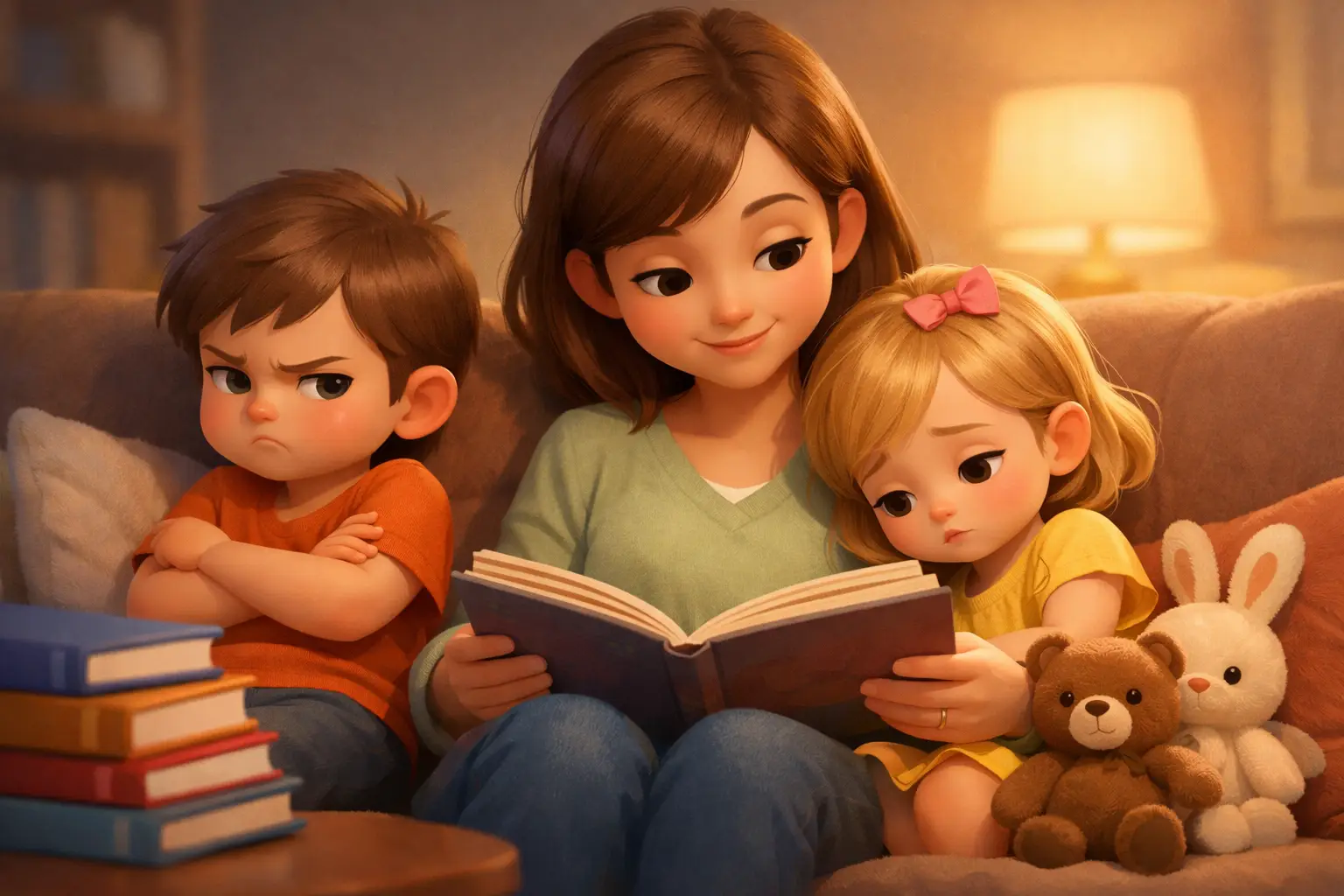
A fight over the blue cup can feel very big when you are four. So can hearing a baby cry from Mom’s lap, watching an older sibling do something you cannot do yet, or waiting while someone else gets help. The best books for sibling rivalry make room for those tender, prickly feelings without making a child feel bad for having them.
For children ages 3 to 6, a helpful sibling story does more than say, “Be nice.” It lets children see jealousy, frustration, love, and repair playing out safely on the page. Then, when a hard moment happens at home, they have words for it: “I wanted a turn,” “I miss having you to myself,” or “Can we start over?”
What makes a sibling story truly helpful?
The most comforting books do not pretend siblings are cheerful playmates every minute of the day. They show that two things can be true at once: a child can love their brother or sister deeply and still feel angry when that sibling takes a toy, gets attention, or breaks a carefully built tower.
Look for stories with a manageable problem, warm adult guidance, and an ending that offers connection rather than perfection. A book does not need to end with siblings suddenly sharing every possession. Sometimes the most realistic ending is a small repair: a kind word, a new game, a defended little brother, or room for both children to belong.
The child’s age and the reason behind the conflict matter, too. A child adjusting to a new baby may need a different book than two preschoolers who argue over toys each afternoon. Here are gentle choices for several common moments.
Best books for sibling rivalry at ages 3-6
Julius, the Baby of the World by Kevin Henkes
Lilly is not impressed by her new baby brother. In fact, she has plenty to say about how noisy, smelly, and uninteresting he seems. The humor gives children permission to laugh at feelings they may be nervous to admit.
What makes this story especially lovely is its turn toward loyalty. When someone else says something unkind about Julius, Lilly discovers that her feelings are complicated. She may be annoyed with her brother, but he is still hers. This is a wonderful choice for a child who is learning that jealousy and love can sit side by side.
Peter’s Chair by Ezra Jack Keats
A new baby is using Peter’s old things, and Peter decides he has had enough. He drags his little blue chair away, hoping to keep one small piece of his earlier life for himself.
The story is quiet and simple, which makes it especially good for children facing a new sibling or another family transition. Peter’s parents do not scold him for feeling upset. They notice, stay close, and help him see that growing does not mean being replaced. Read this one slowly, especially if your child is grieving the change from being the only child.
The Pain and the Great One by Judy Blume, illustrated by James Stevenson
This book tells the same family life from two points of view. The older sibling thinks the younger one gets away with everything. The younger sibling is equally sure that the older one has all the advantages.
That balance is its gift. Neither child is labeled the troublemaker, and neither point of view is treated as silly. After reading, you might gently ask, “Which part felt familiar?” You may hear a surprising answer. Children often soften when they realize their sibling may be having hard feelings, too.
I Am the Boss of This Chair by Carolyn Crimi, illustrated by Marisa Morea
A young girl loves her special chair, until her little brother decides it is special, too. The problem is small enough for preschoolers to understand, but the feelings are not small at all. Personal space, ownership, and a younger sibling’s persistence can be very real sources of conflict.
This is a useful book for families working on boundaries. It opens a conversation about what can be shared, what needs permission, and how a grown-up can help when both children want the same thing. The solution is playful, but it does not require the older child to give up every need.
Mine! by Jeff Mack
Two mice find one rock and both claim it immediately. Their argument grows louder and more ridiculous until the rock is no longer the only thing they need to worry about.
With very few words and expressive pictures, this book is easy for young children to follow. It works well before a playdate, after a hard sharing moment, or when everyone in the house seems stuck on one word: mine. The story can help children notice how quickly a small disagreement becomes a bigger problem when no one pauses.
Big Red Lollipop by Rukhsana Khan, illustrated by Sophie Blackall
When Rubina is invited to a birthday party, her mother asks her to bring along her younger sister, Sana. Rubina feels embarrassed and angry when Sana takes the party’s special red lollipop. Years later, the sisters meet a similar moment with a younger sibling of their own.
This is a particularly thoughtful choice for older preschoolers and kindergarteners who can follow a slightly longer story. It handles exclusion, embarrassment, and family expectations with tenderness. It also shows that an older sibling can make a kinder choice without pretending the earlier hurt never happened.
Just Like a Baby by Mercer Mayer
Little Critter sees the baby getting attention and decides that acting like a baby might be the way to get some, too. The story is warm and funny, while still naming a feeling many children know well: “What about me?”
Choose this book for a child who has become clingier, more tearful, or suddenly less independent after a new baby arrives. Those changes are often a request for reassurance, not misbehavior. Afterward, offer a little one-on-one time, even if it is only ten quiet minutes together.
The Sibling Book by Todd Parr
Bright, simple, and welcoming, this book celebrates many kinds of siblings and many ways they can be alike or different. It does not focus on one big conflict, which makes it a gentle starting point for younger children or for families who want to talk about sibling identity before problems arise.
Its message is easy to carry into daily life: siblings may disagree, but each child has their own place in the family. For some children, especially those who compare themselves often, that reminder can feel like a deep breath.
How to use these books after a hard moment
A sibling book is most useful when it is not used as a consequence. If a child has just shoved, screamed, or grabbed, asking them to sit through a lesson may feel like one more demand. Start with safety and calm first. Separate bodies if needed, offer a drink of water or a cozy corner, and help everyone’s nervous system settle.
Later, bring out a story when the room is peaceful. You might say, “This book has a character who wanted something all to herself. Sometimes that feeling visits our house, too.” Keep the invitation light. A child does not have to explain themselves right away for the story to help.
After reading, one or two questions are enough: “How did that character feel?” and “What could help next time?” For very young children, offer simple choices: “Do you need a turn, a different toy, or help from me?” Repetition matters more than a perfect conversation.
A small reminder for parents and caregivers
Sibling rivalry is not proof that children are unkind or that a family is doing something wrong. Often, it is a child’s clumsy way of saying, “I need to know there is enough love, attention, space, and safety for me, too.”
Stories can make that need easier to hear. Read one at bedtime, tuck it into a quiet afternoon, or return to a favorite after a difficult day. Little by little, children learn that big feelings can be named, needs can be spoken, and even after a stormy moment, there is a way back to each other.