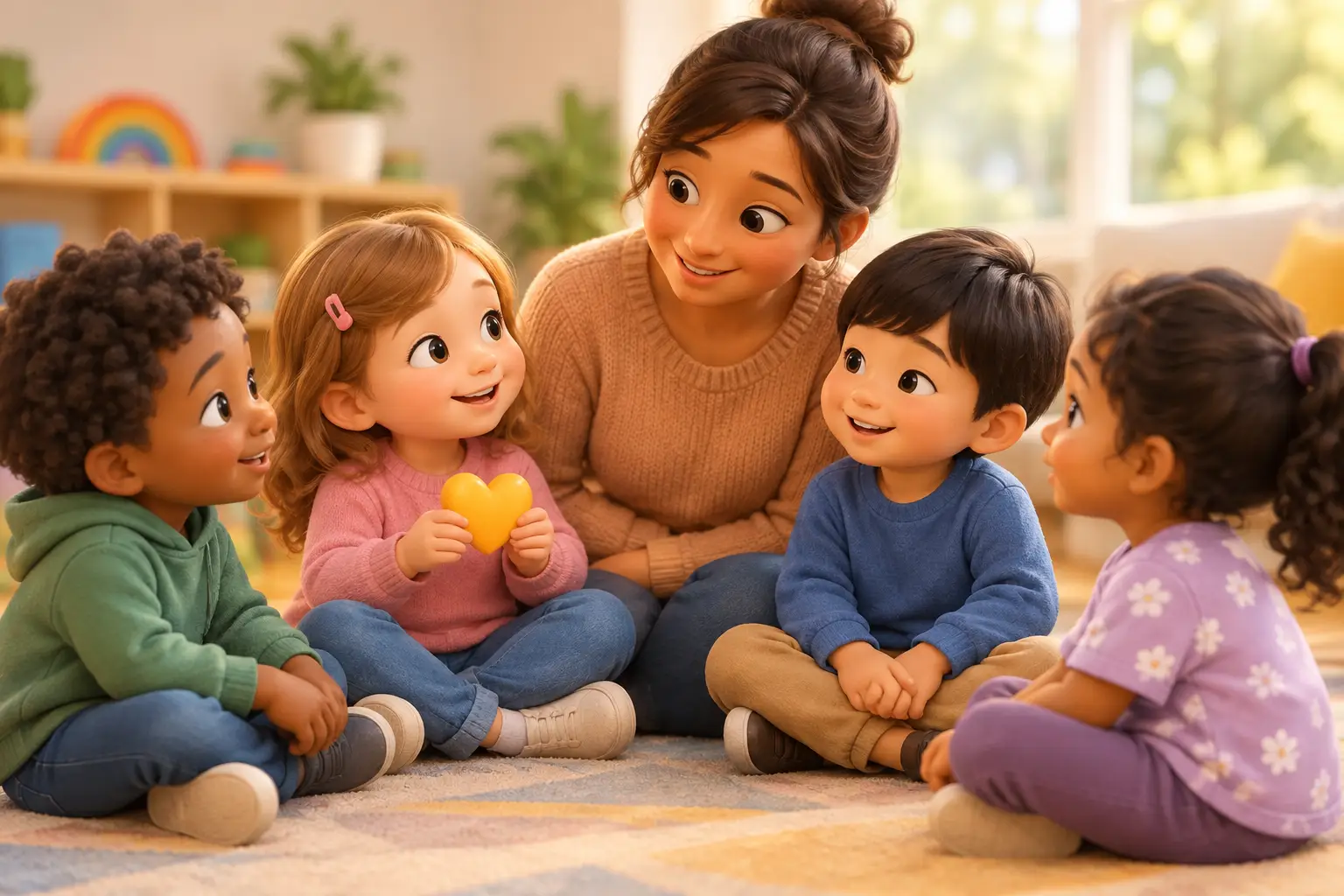
A child does not need a big speech to feel that they belong. Sometimes it is hearing their name in a welcome song, finding a place for their drawing on the wall, or having a friend save them a spot at the snack table. These belonging activities for preschoolers create small, repeatable moments that say, “There is room for you here.”
For children ages 3 to 6, belonging is not an abstract idea. It is a feeling in their bodies: safe enough to join a game, brave enough to speak, and comforted when they make a mistake. The goal is not to make every child participate in the same way. The goal is to build a warm little community where each child can be seen, heard, and welcomed.
Why belonging matters in the preschool years
Preschoolers are learning that other people have thoughts, feelings, traditions, and preferences that may be different from their own. They are also learning a tender truth: they can be themselves and still be part of the group.
When children feel included, they are often more ready to practice sharing, listening, taking turns, and recovering after conflict. A child who hangs back at first may need time to watch before joining. A child who speaks loudly may need a gentle reminder that everyone gets a turn. Both children deserve a place in the circle.
These activities work best when they become part of a familiar rhythm. One thoughtful moment each day is usually more meaningful than a large lesson that happens once and disappears.
Belonging activities for preschoolers to use all week
1. Make a welcome ritual
Begin the day with the same simple greeting. You might sing each child’s name, offer a wave, or say, “Good morning, Maya. We are glad you are here.” Let children choose how they want to respond: a high-five, a quiet nod, a hand on their heart, or simply listening.
Choice matters. Some children love being noticed in front of a group, while others feel safest with a quieter welcome. A predictable greeting tells every child that they were expected and that their presence matters.
2. Create a “we belong” wall
Set aside a space for family drawings, self-portraits, photos, or a simple page that says, “This is me.” Invite children to share only what feels comfortable. A child might draw the people they live with, a pet, a favorite meal, or the park they love.
Use open language rather than assuming every family looks the same. Say, “Tell us about someone who cares for you,” instead of asking every child to draw a mom and dad. The wall becomes a gentle reminder that there are many loving ways to be a family.
3. Pass a friendship pebble
Choose a smooth, child-safe pebble or other small object to pass around during circle time. Whoever holds it can share one thing: something that made them smile, a person who helped them, or a kind thing they noticed. Children may always say, “Pass,” if they do not want to speak.
This activity teaches listening without turning sharing into a performance. The pebble gives a visible cue that one person is talking and the group is making room. For younger preschoolers, keep prompts very short: “What felt good today?”
4. Read a story, then give it a new ending
Choose a calm story about a character who feels left out, nervous, new, or different. Pause at a hard moment and ask, “What could a friend do now?” Children may suggest inviting the character to play, sitting beside them, asking if they are okay, or making space at the table.
Then let them act out the new ending with stuffed animals or simple paper puppets. Stories provide enough distance for children to talk about big feelings safely. A child may find it easier to say, “The bunny needs someone,” before they can say, “Sometimes I need someone, too.”
5. Build one shared creation
Offer a large sheet of paper, a cardboard box, blocks, or a blanket fort, and invite children to make something together. Give the project a caring purpose: a cozy home for woodland animals, a garden for pretend butterflies, or a bridge that helps everyone get across the river.
The learning is in the conversation around the project. You can gently narrate what you see: “Eli made room for Nora’s block,” or “You both had ideas, so you found a way to use both.” If conflicts arise, do not rush to solve every problem. Help children name the need beneath it: “You both want the blue block. What could help?”
6. Practice noticing kind moments
At the end of the day, invite children to notice one kind thing they saw. Keep the language concrete. “Who helped someone?” “Who made space?” “Who used gentle hands?” Write their words on paper hearts or draw a small picture beside each idea.
Be careful not to turn kindness into a contest. The quiet child who offered a crayon deserves the same warm recognition as the child who made a grand gesture. Over time, children begin to look for chances to care because they understand that caring helps the whole group feel safe.
7. Sing songs with everyone’s name
Name songs are simple, memorable, and especially comforting during transitions. Try a tune with repeating words such as, “We’re happy you are here, we’re happy you are here, [name], [name], we’re happy you are here.” Add motions so children can participate before they are ready to sing.
You can also include children’s ideas in the song: “Jordan likes to stomp,” or “Ava likes to twirl.” Keep descriptions positive and avoid putting children on the spot about traits they may not want announced. A name song should feel like an invitation, never a label.
8. Set up a buddy invitation game
During free play, model easy words children can use to invite one another in: “Do you want to build with me?” “You can have this one.” “There is room here.” Practice with dolls first, especially if children are still learning how to enter play without grabbing or interrupting.
Not every invitation will be accepted, and that is part of the learning. Teach a gentle response for both sides. A child can say, “Not right now, but you can play after,” or “We are making a zoo. You can make the pond.” Belonging does not mean children must give up all boundaries. It means they learn to use boundaries with care.
9. Make a feelings-and-friends calm corner
A calm corner can be more than a place to cool down. Include soft pillows, a few feeling faces, paper and crayons, and a basket of comforting books or stuffed animals. Explain that this is a place anyone can use when they need quiet, courage, or help getting ready to rejoin.
Teach children a few words they can borrow: “I need space,” “Can you sit with me?” and “I am ready to try again.” When a child has a hard moment, avoid presenting the calm corner as punishment. It should feel like a warm pause, not being sent away from the group.
10. Close with a circle of appreciation
Before a child leaves, offer a brief closing phrase: “Thank you for being part of our day.” In a family setting, this might happen at bedtime. In a classroom, it may be part of dismissal. You can mention one real moment from the day: “I noticed you kept trying with that puzzle,” or “Your idea made our block town more interesting.”
Specific appreciation helps children understand that belonging is not earned by being perfect, quiet, or cheerful all the time. They matter because they are here, and their presence adds something to the group.
Helping a child who is slow to join in
Some preschoolers run toward new friends. Others stay close to a trusted adult, watch from the edge, or need many visits before they feel ready. There is nothing wrong with a slow warm-up. Gentle belonging grows from safety, not pressure.
Offer a small job, such as carrying napkins, choosing a book, or placing a friend’s name card on the table. Join the child in parallel play rather than insisting they enter a group game. You might say, “We can watch together,” or “I will stay close while you try one block.” Tiny steps count.
If a child regularly seems distressed, withdrawn, or unable to join everyday routines, speak with their teacher or pediatrician for thoughtful support. Most of all, keep the message steady: big feelings are welcome, and help is nearby.
Belonging often begins in the quietest moments: a saved seat, a familiar song, a caring hand held out and waiting. When children experience those moments again and again, they carry a gentle truth with them: there is room for me, and there can be room for others, too.