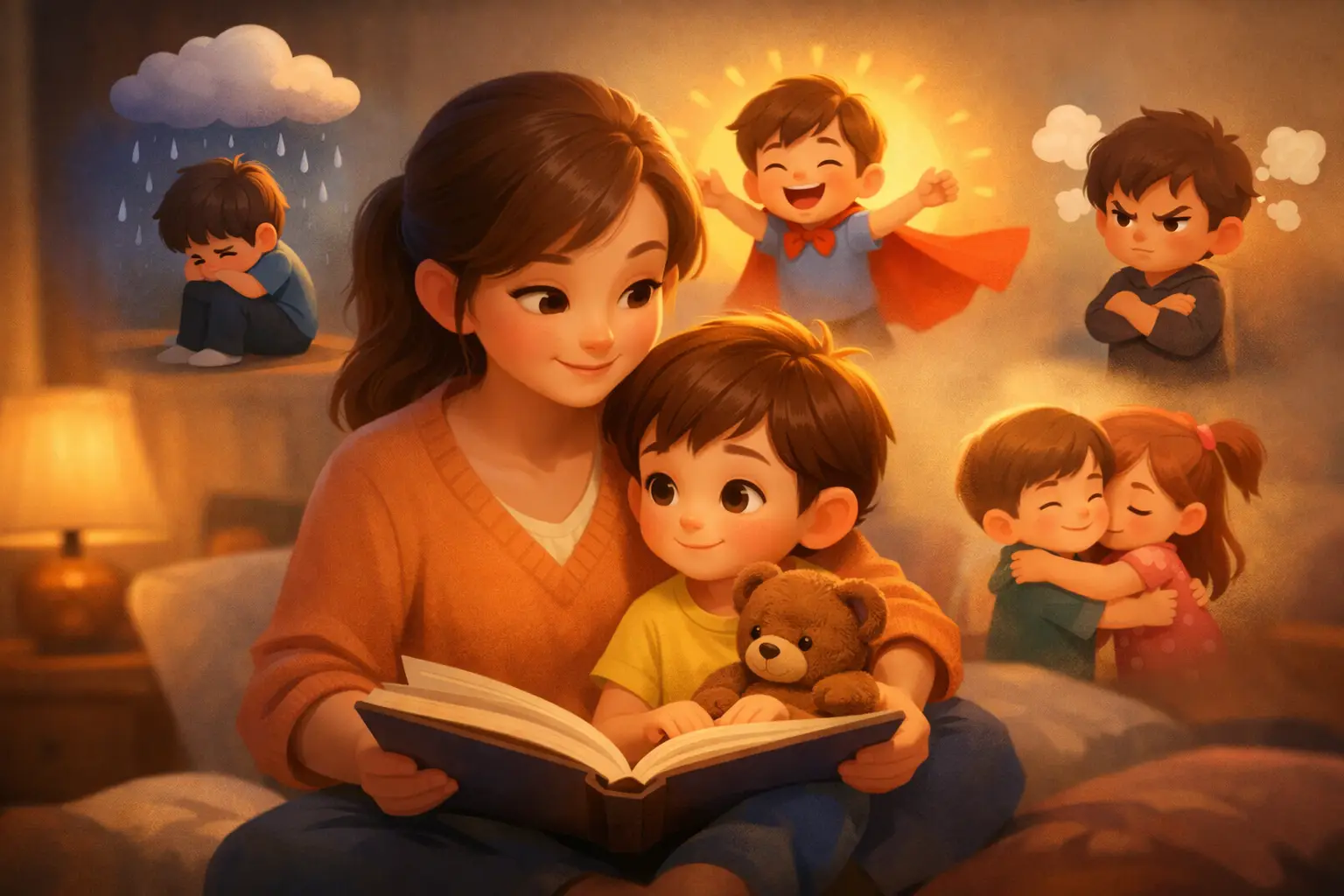
A child melts down over the wrong cup, hides behind your leg at a birthday party, or whispers that bedtime feels scary tonight. In moments like these, stories to help kids with feelings can do something simple and powerful - they make a child feel less alone.
For children ages 3 to 6, feelings often arrive before words do. A preschooler may not be able to explain, "I feel left out," or "I'm overwhelmed," but they can recognize a shy bunny, a worried bear, or a little pebble-hearted character who feels the same way. That is why gentle storytelling matters. It gives children a safe place to see emotions, name them, and practice moving through them.
Why stories work so well for big feelings
Young children learn through repetition, rhythm, and images they can hold onto. A calm story slows a feeling down enough for a child to look at it. Instead of being inside the storm, they get to watch it happen to someone else first.
That little bit of distance matters. A child who refuses to talk about anger may happily talk about a fox who stomped and shouted when his block tower fell. A child who feels nervous at preschool drop-off may open up about a duckling who missed home. The story becomes a bridge. It is not a lecture, and it does not ask too much too fast.
Stories also help because they offer shape. Big feelings can seem sudden and endless to young children. In a comforting story, something happens, a feeling rises, support appears, and the feeling shifts. Not always all at once, and not always neatly, but enough for a child to sense that feelings move. They do not stay huge forever.
What makes stories to help kids with feelings actually helpful
Not every story about emotions feels soothing. Some are too busy, too loud, or too determined to teach a lesson before a child has had time to feel understood. The most supportive stories tend to share a few quiet strengths.
First, they make the feeling feel normal. A child does not need a story that treats sadness or jealousy like a problem to erase. They need a story that says, in gentle ways, "This happens. You are still safe. You are still lovable." That kind of emotional validation lowers shame, which is often what makes feelings harder.
Second, they stay close to a child’s world. For ages 3 to 6, the most meaningful stories are usually about everyday moments - sharing toys, making mistakes, missing a parent, feeling left out, hearing a scary sound at night, trying something new. These are the places where emotional learning sticks because children can recognize themselves.
Third, they offer comfort without pretending everything is instantly fixed. Sometimes the best ending is not "and then he was never scared again." Sometimes it is "he took a breath, held a friend's hand, and felt brave enough for one small step." That kind of ending feels true. It teaches resilience in a way young children can trust.
The feelings children most often need help with
Parents often look for stories when a specific struggle keeps showing up. Anger is a common one, especially when a child does not yet know how to pause between feeling upset and acting on it. A good anger story does not shame yelling or stomping. It shows what anger feels like in the body and gives the child a path back to calm.
Worry and bedtime fears are another big category. At this age, imagination is vivid, and that can be lovely until shadows look suspicious or tomorrow feels too unknown. Stories can gently shrink those fears by naming them, softening them, and surrounding the child with safety, routine, and reassurance.
Sadness and disappointment matter just as much. A scraped knee, a canceled outing, a friend who does not want to play - these moments feel enormous to little kids. Stories help children learn that sadness can be held. It does not have to be rushed away.
Then there are the social feelings that are harder to spot at first glance: jealousy, embarrassment, loneliness, and the sting of making a mistake. These feelings often hide underneath behavior parents find confusing. A gentle story can bring them into the open without pressure.
How to choose the right stories to help kids with feelings
It helps to think less about finding the perfect story and more about finding the right match for your child, your moment, and the feeling in front of you. Some children respond best to very soft bedtime-style stories. Others need a little more humor or a character with a familiar struggle.
Look at pacing first. If your child is sensitive or easily overstimulated, a slower story with calm illustrations and simple language will usually help more than something fast and flashy. A story meant to support emotional regulation should feel steady in the body, not busy.
Look at emotional clarity too. For preschoolers, it helps when the feeling is easy to recognize. A character who says, "My tummy feels tight," or "I want to hide," gives children concrete clues. Abstract messages can miss the mark at this age.
It is also worth noticing whether the story leaves room for connection. The strongest stories often include a caring adult, a trusted friend, or a comforting routine. That matters because children do not just need coping skills. They need to see that support is part of coping.
Reading stories about feelings in a way that helps
The story itself matters, but the way you share it matters too. You do not need a perfect script. In fact, the gentlest conversations are usually the simplest ones.
Read slowly enough for your child to notice expressions, pauses, and changes in the character’s body. If your child points something out, stay there. You do not have to finish every page on schedule. Sometimes the best part of the story is the moment your child says, "I feel like that too."
Keep your questions soft and optional. Instead of asking, "What is the lesson?" you might say, "I wonder if the bunny felt lonely there," or "Have you ever had a day like that?" Some children will answer right away. Others will store the story quietly and bring it back later in the car or at bedtime.
Repetition is especially helpful with emotional stories. Children often ask for the same book or video again and again, not because they are being repetitive for no reason, but because they are practicing something internally. Each rereading makes the emotional path more familiar.
When stories are enough, and when they are not
Stories are wonderful tools, but they are still tools. They can open a door, soften a hard moment, and give children language they did not have before. They cannot replace deeper support when a child is struggling in a bigger way.
If a feeling seems intense, constant, or disruptive over time, it may help to look beyond books and videos alone. Sleep changes, daily meltdowns, strong separation distress, or ongoing worries can be signs that a child needs more support from caregivers, teachers, or a pediatric professional. There is no failure in that. Stories and extra support can work beautifully together.
Even in less serious seasons, some children do not respond to stories right away. That does not mean the story is wrong or your child is doing it wrong. It may simply mean they need movement, music, drawing, or quiet closeness first. Emotional support is rarely one-size-fits-all.
Creating a home where feelings feel welcome
Stories do their best work when they are part of a larger emotional rhythm at home. A child who hears gentle language about feelings during the day is more likely to connect with that same language in a story at night.
That can be as simple as naming what you see. "You look disappointed." "That was frustrating." "You wanted more time." These small moments teach children that feelings can be noticed without being feared. When a story later reflects the same truth, it feels familiar instead of forced.
This is one reason many families are drawn to calm, emotionally supportive storytelling from places like Cozy Pebble Stories. The goal is not to entertain a feeling away. It is to sit beside it, make it understandable, and help a child believe that hard moments can be carried with care.
A good story will not make every tear disappear or every bedtime easy. But it can give your child a gentle sentence to hold onto, a character to remember, and a softer path through feelings that once felt too big. Sometimes that is exactly what a young heart needs.