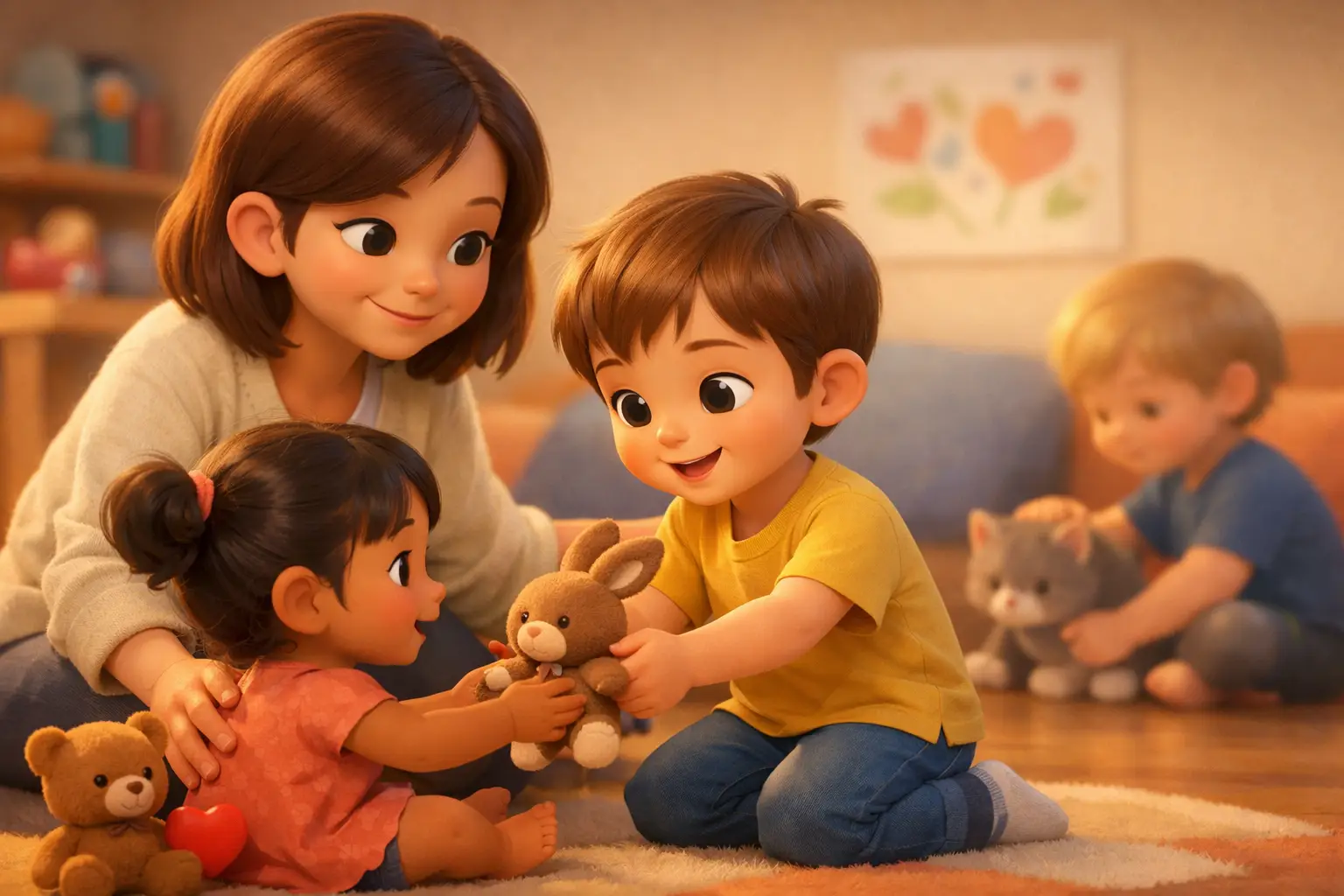
One of the clearest moments in early childhood happens fast: one child is crying, another child is watching, and you can almost see the question forming - What do I do now? If you are wondering how to teach kindness to preschoolers, that is often where the real work begins. Not with a lecture, but with a small, ordinary moment when a child needs help noticing someone else’s feelings and learning a gentle way to respond.
Kindness at this age is rarely polished. A preschooler may offer a favorite toy one day and grab a toy away the next. That does not mean the lesson is not working. It means kindness is still growing, right alongside language, self-control, and emotional awareness.
What kindness looks like in the preschool years
For adults, kindness can sound like a value. For preschoolers, it needs to feel concrete. It looks like making room on the rug, patting a friend’s shoulder, helping pick up spilled blocks, or using a soft voice when someone is sad.
This is also the age when children are still deeply centered on their own needs. That is developmentally normal. A child who says, "I want it now" is not failing a character test. They are still learning that other people have feelings, wishes, and limits too. Teaching kindness works best when we remember that empathy begins as a practice, not a personality trait.
Some children seem naturally gentle. Others are more impulsive, sensitive, shy, or strong-willed. All of them can learn kindness. They just may need different kinds of support.
How to teach kindness to preschoolers in everyday life
The most effective kindness lessons usually happen in the quiet middle of the day. Preschoolers learn through repetition, imitation, and simple language they can use again later.
Start by naming what kindness is when you see it. Instead of broad praise like "Good job," try something more specific: "You brought your sister her blanket. That was kind." This helps children connect the action with the idea. Over time, they begin to recognize kindness as something real and doable.
It also helps to keep your words short. In a hard moment, a preschooler is not ready for a long explanation about empathy. They can hear, "He is sad. Let’s help," or "Her hands are full. We can hold the door." Small phrases are easier to remember and repeat.
Modeling matters even more than explaining. Children notice how adults speak to cashiers, pets, grandparents, and each other. They notice whether we apologize, whether we wait our turn, and whether we stay gentle when we are frustrated. If we want kind children, they need to live beside kindness often enough to recognize its shape.
Use stories and pretend play to make kindness feel safe
Preschoolers often understand big ideas better through a little distance. A story character who feels left out can help a child talk about exclusion without feeling defensive. A stuffed bear with a bumped knee can invite caretaking in a way that feels natural and calm.
This is one reason stories are so powerful for social-emotional learning. In a gentle story, children can watch a problem unfold slowly enough to understand it. They can see what hurt someone, what helped, and what repair looked like afterward. Kindness becomes more than "be nice." It becomes a sequence they can follow.
Pretend play works the same way. You might act out a scene with dolls where one doll feels lonely at snack time. Then ask, "What could the friend do?" A preschooler may come up with something simple like sharing crackers or saying, "Sit by me." That small answer matters. It means they are practicing kindness while feeling safe and playful.
For families who already use bedtime stories, songs, or calm character videos as part of their routine, this can be a natural place to reinforce kind behavior. Gentle, repeatable stories tend to stay with children because they make emotional lessons feel manageable.
Teach the words that make kindness easier
Sometimes children are not unkind. They are simply missing the language they need.
A preschooler who snatches a toy may really mean, "Can I have a turn?" A child who walks away from someone crying may not know how to begin. When we offer kind scripts, we lower the pressure and give them something solid to use.
Useful phrases include, "Do you want help?" "You can go first." "Are you okay?" "I’m sorry." "Can I play too?" and "You can have a turn when I’m done." These phrases are short, warm, and practical. They help children act kindly even before empathy feels automatic.
It can help to practice these words before they are needed. Try them during play, at dinner, or in the car. If your child is slow to speak in social settings, practice matters even more. Kindness comes more easily when the language is familiar.
Make repair part of the lesson
A loving home or classroom will still have hitting, yelling, toy grabbing, and hurt feelings. Teaching kindness does not mean preventing every unkind moment. It means helping children learn what to do after one.
That is where repair becomes so important. If a child knocks over a friend’s tower in anger, the lesson is not only "We don’t do that." It is also, "Your friend is sad. Let’s help fix it." Repair might mean rebuilding, getting ice for a bumped arm, drawing a picture, or offering a sincere apology.
Not every child is ready to say sorry right away. Some children need to calm their body first. Some need help understanding what happened. A rushed apology can sound empty, especially if the child still feels overwhelmed. It is okay to slow down. Kindness includes accountability, but it also grows best in safety.
Create small routines of kindness
If you want kindness to become part of family life, give it a place to land. Preschoolers respond well to small rituals because they make abstract values feel steady and familiar.
You might ask at bedtime, "What was one kind thing you did today?" or "Did someone do something kind for you?" You might invite your child to help set the table for everyone, check on a sibling, or choose a neighbor who could use a cheerful drawing. These little routines teach children that kindness is not only for big emotional moments. It belongs in ordinary life.
There is a balance here. If kindness starts to feel like a performance, some children will resist it. Others will do kind things only for praise. Try to keep the focus on connection rather than reward. Warm acknowledgment is helpful. Constant prizes are not.
When kindness is harder for some children
Some preschoolers feel everything deeply. Some struggle with transitions, sensory overload, or waiting. Some are still learning to notice other people when their own feelings are very big. In these moments, teaching kindness may first mean helping a child regulate.
A dysregulated child cannot easily offer empathy. They may need a quiet corner, a hug, a drink of water, or a few calm breaths before they can think about anyone else. This is not lowering expectations. It is recognizing the order in which children develop skills.
It also helps to be careful with labels. Saying "You’re not being nice" can make a child feel fixed in shame. Saying "That hurt your friend. Let’s try again gently" keeps the door open. The goal is to guide behavior without telling children they are bad.
If your child is especially shy, kindness may look quieter. They may not rush over to comfort a crying peer, but they might quietly bring over a stuffed animal or stand nearby. That still counts. Kindness does not always look bold.
Praise the process, not perfection
When parents think about how to teach kindness to preschoolers, it is easy to hope for visible results right away. But kindness is built in layers. A child first notices distress, then learns a phrase, then offers help with prompting, and only later begins to act with more independence.
That means progress can look uneven. Your child may be wonderfully caring with a baby cousin and still rude to a sibling before breakfast. That is frustrating, but normal. Preschoolers are still learning how to carry a skill across settings, moods, and relationships.
Notice the small signs. A pause before grabbing. A soft hand instead of a push. A whispered "Are you okay?" to a friend on the playground. Those moments deserve your attention because they show the lesson is taking root.
Children do not learn kindness from pressure alone. They learn it from living with it, practicing it, and being given another chance after they miss the mark. A gentle story, a repeated phrase, a repaired mistake, a parent who stays calm enough to teach - these are the pebbles that slowly shape a kind heart.
And when the day feels messy, it helps to remember this: every tender response your child sees and hears is part of the lesson, even when it seems small.