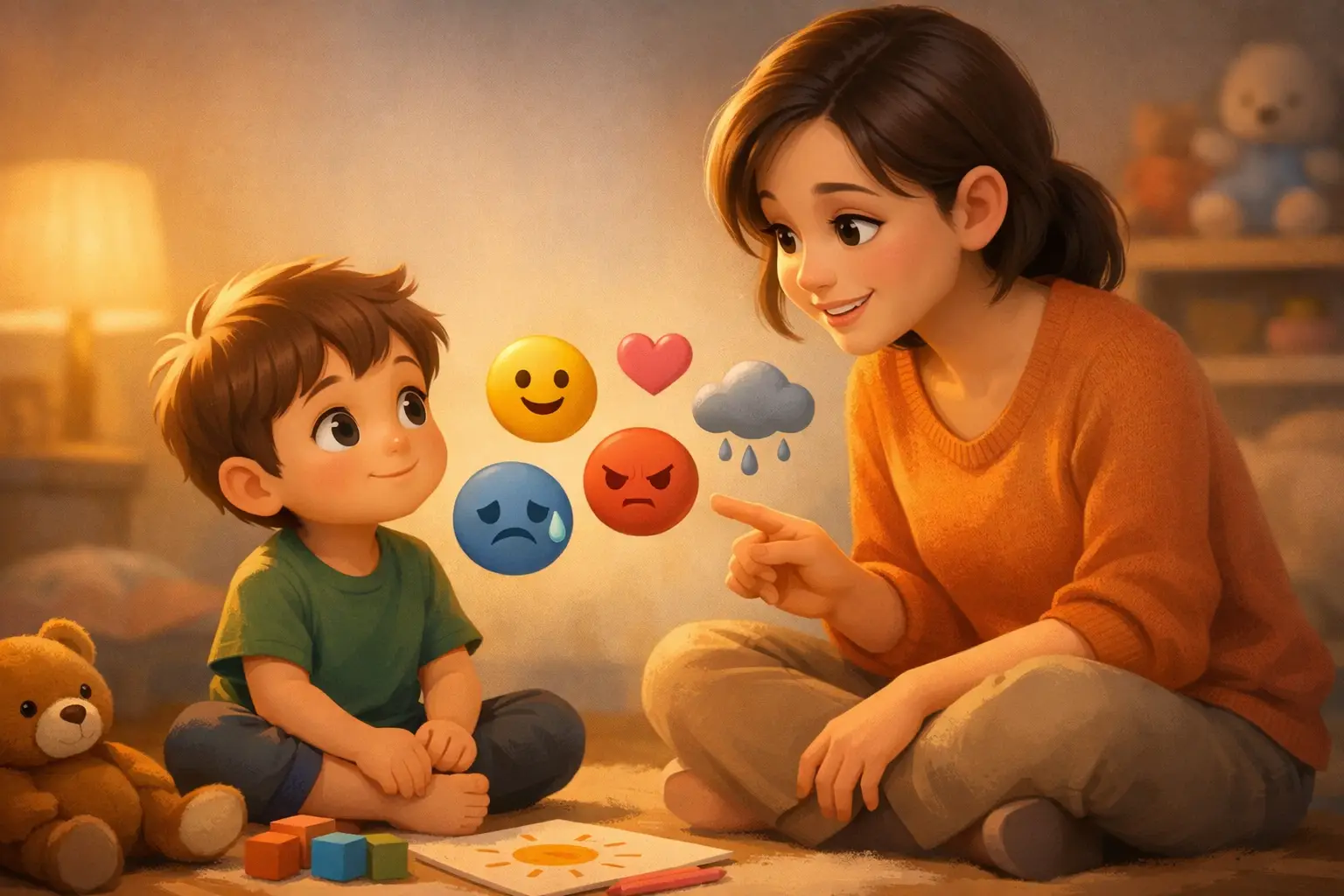
A preschooler can go from giggling over blueberries to sobbing because the toast was cut the wrong way. To adults, that shift can feel sudden. To young children, it often feels enormous and real. If you are wondering how to explain feelings to preschoolers, the kindest place to begin is here: feelings are not a problem to fix. They are messages to notice, name, and move through together.
At this age, children are still building the words for what happens inside them. They may know happy and sad, but frustrated, disappointed, worried, jealous, and proud are much harder to hold. That is why simple language matters so much. Preschoolers do not need a long lesson on emotional regulation. They need a calm grown-up, a few clear words, and the steady reminder that all feelings are allowed, even when some behaviors are not.
Why feelings can seem so big at ages 3 to 5
Preschoolers live close to the surface of their emotions. Hunger, noise, tiredness, change, and disappointment can all make feelings swell quickly. They also think in concrete ways, so abstract explanations usually miss the mark. Saying, "You need to process your emotions" will mean very little. Saying, "Your body looks tight. I think you feel mad," gives them something they can recognize.
It also helps to remember that young children often show feelings before they can describe them. A child who throws a shoe may actually feel embarrassed. A child who hides behind your leg may be overwhelmed, not unfriendly. When we look underneath the behavior, we can respond with more gentleness and less frustration.
How to explain feelings to preschoolers in simple ways
The most helpful explanations are short, warm, and easy to repeat. You might say, "Feelings are what happens inside us when something changes, happens, or matters to us." For a three- or four-year-old, even simpler is often better: "Feelings are how our hearts and bodies tell us something."
Then connect feelings to things they already know. "Happy can feel light and smiley. Sad can feel heavy and droopy. Mad can feel hot and tight. Worried can feel wiggly or fluttery." This gives children a bridge between body sensations and emotional words.
Repetition matters more than perfection. You do not need the perfect script. Preschoolers learn through hearing the same calm message many times in many small moments. Over time, they begin to borrow your words as their own.
Start with a few core feeling words
Instead of teaching every emotion at once, begin with a small handful: happy, sad, mad, scared, and calm. Once those feel familiar, add words like frustrated, disappointed, excited, shy, and proud.
There is a trade-off here. If you introduce too many feeling words too quickly, children may tune out or mix them up. If you stay too general for too long, they may not learn the more precise words that help them communicate. A gentle middle ground works best - start small, then slowly widen the circle.
Use real-life moments, not only teaching moments
Children learn feelings best when the words match something happening right now. If your child is crying because a block tower fell, that is a better lesson than a flashcard. You might say, "You worked hard on that tower. Now it fell. You look frustrated and sad." If a sibling gets the bigger cookie, you can say, "I think you feel disappointed. You wanted the big one."
This kind of naming is powerful because it helps children feel seen. They may still cry, but the crying becomes less lonely.
Keep explanations concrete and sensory
Preschoolers understand the world through what they can see, hear, feel, and imagine. So when you explain emotions, use body clues, faces, and everyday examples. "Mad can make your fists squeeze." "Worried can make your tummy feel funny." "Excited can make your feet want to jump."
You can also compare feelings to weather in a simple way. "Sometimes feelings are sunny. Sometimes they are stormy. Both kinds pass." That kind of image is gentle and memorable without becoming too abstract.
For some children, pretend play works even better than direct conversation. A stuffed bear can feel nervous about the dark. A bunny can feel left out when a friend runs ahead. When children help a character with feelings, they often begin to understand their own.
What to say when a child is upset
When emotions are high, less is usually more. A child in the middle of a meltdown is not ready for a big explanation. First offer safety, then language. You might kneel down and say, "You are having a big feeling. I am here." Once they are a little calmer, add, "Were you feeling mad because it was time to stop playing?"
This order matters. Connection first, teaching second. If we rush straight to correcting or reasoning, children can feel even more flooded. They need help settling before they can learn.
It also helps to avoid telling children what they should feel. "You are okay" may be true from an adult point of view, but a child who feels devastated may hear it as, "Your feeling is wrong." A softer option is, "You are safe. This feels really hard right now." That leaves room for both comfort and truth.
How to explain feelings to preschoolers without making them feel wrong
Children need to hear that all feelings are welcome, while not all actions are. This is one of the most important emotional lessons of early childhood. You can say, "It is okay to feel mad. It is not okay to hit." Or, "It is okay to feel disappointed. We still speak kindly."
That simple boundary helps children separate identity from behavior. They are not bad for having a feeling. They are still responsible for what they do with it, with your support.
Some families worry that talking too much about feelings will make children more upset or overly focused on emotions. Usually, the opposite is true. Naming a feeling often makes it smaller because it becomes understandable. But it does depend on the child. Some preschoolers want to talk right away. Others need a quiet cuddle, a drink of water, or a few minutes of play before words come.
Everyday tools that make feelings easier to understand
The best emotional teaching often happens in calm moments. Picture books, songs, bedtime chats, and simple routines give children a safe place to practice. A child may resist talking about their own fears, but happily talk about a character who feels scared at bedtime. That distance can make hard feelings feel safer to explore.
You can build tiny rituals around this. At dinner, ask, "What made you happy today?" At bedtime, try, "Did anything feel hard today?" Keep it brief and warm. This should feel like an invitation, not a quiz.
Faces can help too. Some children enjoy looking in a mirror and making a happy face, a worried face, or a surprised face. Others like drawing feelings in different colors or acting them out with toy animals. There is no single best tool. The best one is the one your child returns to with ease.
For families who want calm, story-shaped support, gentle media can be especially useful. Soft stories and songs, including those from brands like Cozy Pebble Stories, can give children repeatable language for courage, sadness, friendship, and bedtime worries without making emotional learning feel heavy.
When your child says the "wrong" feeling word
If a preschooler calls every hard feeling "mad," that is normal. Emotional vocabulary grows slowly. You do not need to correct sharply. Just reflect and refine. "You said mad. I wonder if part of it is sad too, because your friend went home." This teaches nuance without pressure.
The same is true if your child denies a feeling you think you see. If you say, "You seem worried," and they shout, "I'M NOT WORRIED," it is usually best not to argue. You can simply say, "Okay. Your body looks a little unsure. I am here if you want me." Children need room to discover their own inner world, not have it announced to them too forcefully.
A gentle script you can return to
When you are not sure what to say, keep it simple: "I see your feeling. It is okay to feel it. I will help you through it." That message gives children three things at once - recognition, permission, and support.
Over time, those small moments build emotional safety. A child who hears feelings named with kindness begins to trust that big emotions can be survived. They learn that sadness does not last forever, anger can be guided, and worry can soften in the presence of a steady adult.
That is the heart of teaching feelings in the preschool years. You are not giving your child a perfect set of words all at once. You are giving them something deeper: the quiet sense that whatever they feel, they do not have to face it alone.