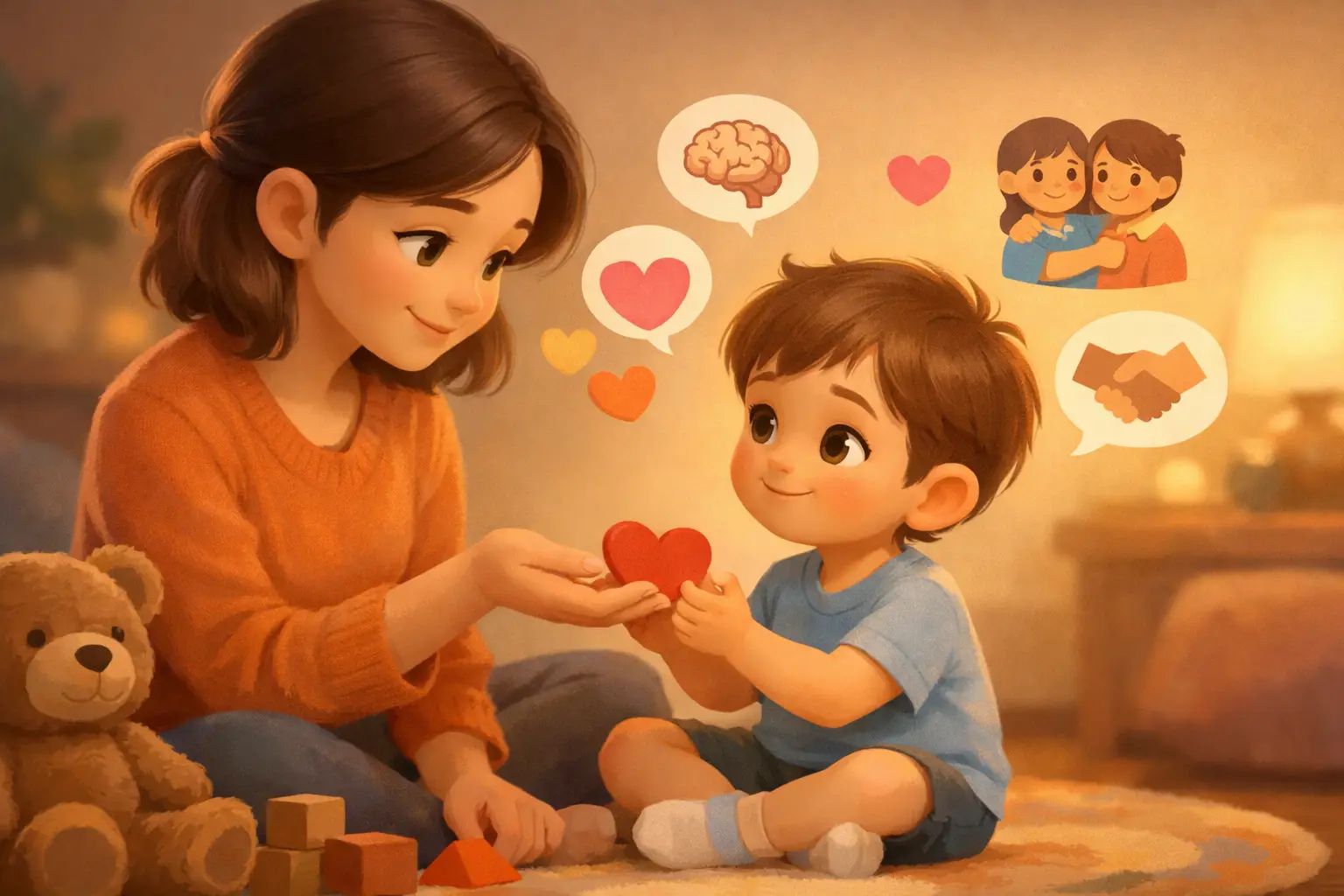
Some days, social emotional learning looks very small. It looks like a child hiding behind your leg at preschool drop-off, or crying because the blue cup is in the dishwasher, or whispering, "I’m not ready yet." A good guide to social emotional learning starts there - not with perfect behavior, but with real children having real feelings and needing a safe place to practice.
For children ages 3 to 6, social emotional learning is the slow, steady work of understanding feelings, building relationships, and learning what to do when life feels hard, disappointing, exciting, or new. It is not about making children behave on command. It is about helping them notice what is happening inside, trust that feelings can be handled, and grow the skills to move through everyday moments with support.
That matters because early childhood is full of firsts. First friendships. First group settings. First big frustrations. First experiences with waiting, losing, apologizing, and trying again. When children are given gentle tools for these moments, they do not become upset less often overnight. But they do begin to recover more safely, connect more kindly, and believe, little by little, "I can do hard things with help."
What social emotional learning really means
Social emotional learning, often shortened to SEL, is the process of helping children recognize emotions, express needs, understand other people’s feelings, and make thoughtful choices. For a preschooler, this can be very simple. It might mean saying, "I feel mad," instead of hitting. It might mean noticing a friend is sad. It might mean taking a breath before trying again.
Adults sometimes hear the term and imagine a school program or a chart on the wall. Those tools can help, but social emotional learning begins long before a formal lesson. It grows in ordinary routines - at breakfast, in the car, during cleanup, at bedtime, and after hard moments when a child needs comfort and direction.
This is also where many parents feel pressure they do not need. SEL is not a test you pass by staying calm every time or by having a perfectly worded script ready. Children learn it through repetition, repair, and relationship. A warm, steady adult matters more than a polished technique.
A guide to social emotional learning at ages 3 to 6
Between ages 3 and 6, children are just beginning to put words around inner experiences. They often feel things very deeply before they can explain them clearly. That gap is normal. A child can be bright, loving, and still fall apart because a sock feels wrong or a block tower tipped over.
At this age, social emotional learning usually centers on a few foundational skills. The first is naming feelings. Young children need simple language like happy, sad, mad, worried, frustrated, shy, proud, and lonely. The second is body awareness. They benefit from hearing that feelings can show up as tight shoulders, a fast heartbeat, tears, or a stomping urge.
Another key skill is impulse support. A 4-year-old may know that grabbing is not kind and still grab when upset. That does not mean the lesson failed. It means the child needs more practice with stopping, waiting, and trying another response. Empathy grows this way too. A child first learns, "I have feelings," then, over time, "Other people have feelings too."
There is a trade-off worth remembering here. We want to teach emotional skills, but we also want to keep expectations realistic. A 3-year-old cannot handle conflict like a 6-year-old. A sensitive child may need more preparation before group activities. A tired child may have fewer coping skills available. Progress is rarely neat.
How parents can teach SEL without making it feel like a lesson
The gentlest way to teach social emotional learning is to weave it into daily life. Instead of sitting a young child down for a long talk, use real moments as they come.
When your child is upset, begin with regulation before correction. A child who is overwhelmed usually cannot learn much from a lecture. First help them feel safe. Sit nearby. Lower your voice. Offer a simple phrase such as, "That felt really disappointing," or, "You’re having a hard time. I’m here." Once the storm softens, you can guide what comes next.
Naming emotions out loud helps children build a usable emotional vocabulary. If your child is clinging to you before a new activity, you might say, "It looks like you’re feeling nervous because this is new." If they are shouting because a game ended, you might say, "You wanted more time. That feels frustrating." This does not approve hurtful behavior. It simply makes the inner experience easier to understand.
Stories are especially powerful here because they create a little breathing room. A child can often talk about a bear who felt left out or a bunny who made a mistake more easily than they can talk about themselves. Soft, character-led stories help children rehearse courage, kindness, and repair in a manageable way. Songs can do something similar by giving children repeatable language they can remember when emotions rise.
Modeling matters just as much. If you say, "I’m frustrated, so I’m going to take one slow breath," you are showing your child what emotional coping looks like in real life. You do not need to model perfection. In fact, repair is one of the strongest lessons children can receive. When you lose patience and come back to say, "I was too sharp. I’m sorry. Let’s try again," you teach accountability and safety at the same time.
Everyday moments that build emotional skills
Many of the best SEL opportunities are so ordinary they are easy to miss. Waiting for a turn helps build patience and frustration tolerance. Pretend play gives children space to act out fears, roles, and solutions. Bedtime conversations often bring up the feelings that were too big or too busy to name earlier in the day.
Transitions are another rich place for learning. Leaving the park, getting ready for school, or saying goodbye to a caregiver can stir up grief, anger, or worry in small bodies. Gentle preparation helps. So does simple consistency. A child who knows what happens next often feels safer handling disappointment.
Conflict between siblings or friends can also become meaningful practice. Rather than rushing only to decide who is right, it helps to slow the moment down. What happened? How did each child feel? What could help now? For very young children, this may be as simple as, "You were using it. He wanted it. Let’s find a way to take turns." The goal is not a perfect mediation. The goal is repeated experience with feelings, limits, and repair.
When social emotional learning feels hard
Sometimes parents worry that they are doing something wrong because their child has frequent meltdowns, intense fears, or trouble with peers. Often, what is happening is more ordinary than it feels in the moment. Young children are still developing language, impulse control, and flexibility. Some also have temperaments that make emotions feel louder, transitions harder, or sensory experiences more overwhelming.
That said, it is fair to pay attention when a child seems persistently stuck. If fears are interfering with daily life, if aggression is constant, or if your child seems unable to recover from distress with support, extra guidance can help. SEL is not about expecting families to carry every challenge alone. Sometimes children need more scaffolding, more time, or support from a pediatrician, teacher, or child development professional.
It also helps to release the idea that calm children are the only sign of success. A child may still cry hard and yet recover faster. They may still get angry and begin using words more often. They may still struggle socially and show more empathy afterward. Growth can be quiet before it becomes obvious.
Why gentle media can support social emotional learning
The media young children spend time with shapes the emotional atmosphere around them. Fast, noisy content can leave some children more dysregulated, especially when they are already tired or sensitive. Calm, emotionally grounded stories tend to do something different. They make space for reflection. They help children see feelings as understandable, not scary.
That is one reason many families seek out soothing books, songs, and story videos that center friendship, worry, courage, and kindness. When children meet comforting characters who feel shy, make mistakes, or need reassurance, they learn that these experiences belong to being human. In a gentle storytelling environment like Cozy Pebble Stories, those lessons can be repeated in ways that feel safe enough to sink in.
The key is not just low stimulation. It is emotional clarity. Children benefit from stories that name feelings simply, show supportive responses, and offer a path forward that feels hopeful and believable.
What to remember as you begin
If you want a practical guide to social emotional learning, start small and stay close. Name feelings. Keep routines steady. Use stories and songs that bring comfort instead of chaos. Hold limits kindly. Repair after hard moments. Trust repetition.
Children do not need adults who can erase every disappointment. They need adults who help make big feelings smaller, clearer, and easier to carry. When that support is present, even ordinary days become a place where empathy, confidence, and resilience begin to grow.